
The Self-Storage Construction Partner Scorecard: 10 Questions Before You Request a Quote
Key Takeaways
A structured construction partner scorecard lets owners compare self storage construction bids on capability and risk, not just unit price.
Storage Building Company (SBC) focuses on multi-story self storage projects and brings integrated design-assist, engineering, and project management across 36 states.
This article walks through 10 concrete questions to ask before requesting a quote, plus how to turn answers into a numeric score using a vendor selection matrix.
The scorecard aligns your evaluation process, selection process, and final decision with long-term NOI and portfolio strategy.
Choosing the wrong vendor can increase project costs by tens of thousands of dollars through change orders, schedule overruns, and lease-up delays when common self storage construction mistakes go unaddressed; the scorecard is built to prevent that.
Why You Need a Construction Partner Scorecard for Your Next Self Storage Project
Self storage construction has shifted since 2020. Multi-story urban infill projects now dominate the development pipeline in high-barrier markets. Fire and life-safety codes have been updated, with the Self Storage Association pushing for storage-specific sections in ICC model codes. Steel and electrical service costs are tracking 4 to 7 percent above prior-year benchmarks. Yield-on-cost expectations in core markets have compressed from roughly 8.5 percent to 7.5 percent, according to Terrapin Construction Group's 2026 data. Under-construction inventory nationally fell from about 3.4 percent of existing stock in August 2024 to approximately 2.7 percent by late 2025, per Yardi Matrix.
For commercial GCs and REITs, the question is no longer "can the vendor build it?" Selecting a construction partner impacts the project's timeline and long-term profitability. You need a partner who delivers predictable outcomes across an entire pipeline of projects, not just a one-off metal building. Vendor selection involves first identifying the critical factors owners will use to compare partners, then evaluating potential suppliers who can handle the complexity of multi-story climate-controlled facilities. Effective vendor selection reduces the likelihood of project delays and protects pro forma returns during a period when every month of lease-up delay erodes NOI.
A one-off bid comparison tells you who is cheapest today. A repeatable evaluation process using a standardized scorecard tells you who will protect your capital across 5, 10, or 20 projects. Asking 10 disciplined questions before any quote request improves decision making and long-term performance. Storage Building Company (SBC), a specialist in multi-story self storage construction with over 321 completed projects and 30 million square feet delivered, encourages owners and GCs to use a formal scorecard when selecting a construction partner.
How the Self-Storage Construction Partner Scorecard Works
The scorecard is a 0-to-100 framework. Before rating vendors, teams create the scorecard or scoring sheet, assign weights to categories, rate each potential vendor on each category, and tally a total score for comparison.
A practical weighting example:
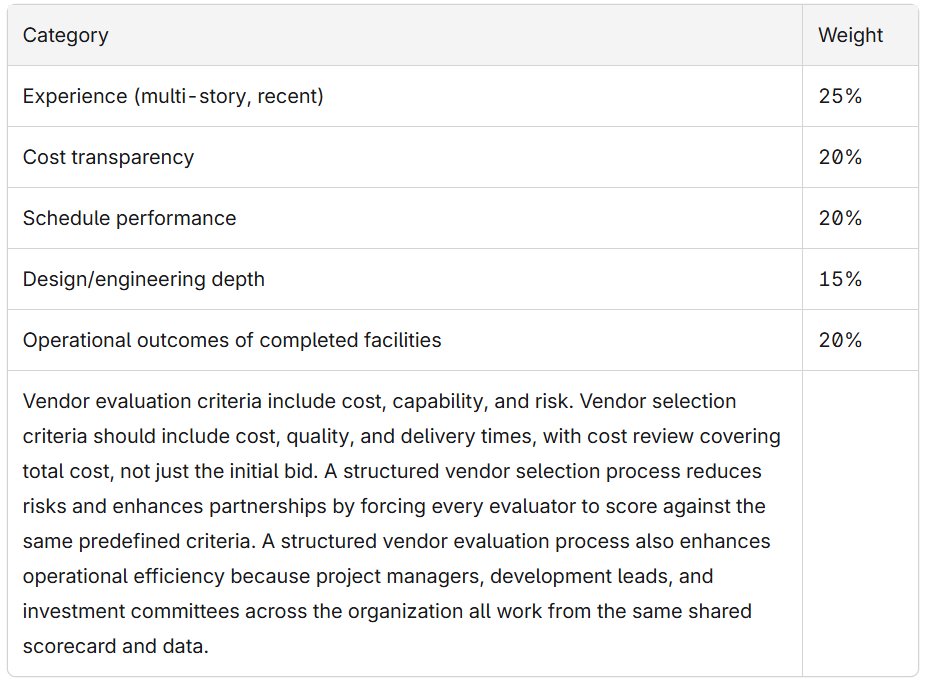
The same scorecard can be reused across multiple markets and cycles. That gives leadership a comparable view of each selected vendor for every self storage development in the portfolio.

Question 1: Does the Partner Have Deep, Recent Multi-Story Self Storage Experience?
Multi-story self storage construction differs from single-story metal building work. It requires planning for elevators, corridors, fire partitions, structural loads, egress, and constrained urban sites. Self-storage contractors vary in service levels offered; some are metal building erectors with no multi-story portfolio, while others are full-service specialists. Self-storage requires specialized knowledge for multi-story designs and unit mix optimization.
Look for at least 5 to 10 completed multi-story self storage projects since roughly 2018, with some delivered after the 2021 code changes. Ask for concrete project examples: city, state, number of stories, gross square footage, and completion dates. Evaluate contractors based on their previous self-storage projects to gauge their technical capabilities in this specific building type.
Score this question higher for partners with repeat business from REITs and institutional owners on multi-story projects in different jurisdictions. SBC specializes in multi-story steel self storage systems and is licensed in 36 states, giving GCs and REITs a portfolio of recent self storage projects with performance data to review.
Question 2: How Early Can They Engage in Design and Preconstruction?
Early design-assist involvement, from schematic design through 50 to 75 percent construction documents, saves time and cost in a self storage project. Top-tier contractors provide design-build services to reduce delays. Design-build capabilities streamline the construction process by combining design and construction services under one team.
A strong preconstruction offering includes constructability reviews, structural system optimization, pricing alternates, and value engineering specific to storage corridors, mezzanines, and partitions. During the interview process, ask: "At what design milestone do you typically join the team?" and "What were your specific preconstruction contributions on your last three self storage jobs?"
Score this area based on whether the vendor provides only pricing or offers full preconstruction services, including BIM coordination and logistics planning for tight urban sites. SBC's teams often join projects 6 to 9 months before groundbreaking to align design, budget, and schedule for multi-story projects, leveraging dedicated multi-story storage expertise to streamline coordination and cost control.
Question 3: What Does Their Self Storage Project Management Spine Look Like?
For REITs and multi-project GCs, you are not buying a building system. You are buying a project management spine that must work in multiple markets. A focus on project management techniques and communication aids in successful self-storage construction. A single point of contact in project management can prevent costly delays in construction.
What to evaluate in their project managers:
Number of active jobs per PM (fewer than 4 to 5 is a positive signal for complex multi-story work)
Experience specifically in self storage construction, not general commercial
Use of standardized project management tools (Procore, BIM 360, or equivalent)
Probe their internal processes for handling RFIs, submittals, coordination with the base-building GC, and change management. Ask about communication cadence: weekly OAC calls, monthly executive reports, and how they plug into your existing systems using the right tools for collaboration.
Score higher for clearly documented processes, dedicated storage-specialist project managers, and proven integration with owner and GC platforms.

Question 4: How Have They Performed on Schedule and Budget in the Last 24-36 Months?
Q1 2026 construction starts trailed Q1 2025 by approximately 29 percent. Steel, labor, and supply chain disruptions from 2022 through 2024 exposed which partners had contingency plans and which did not. Vendor choice directly impacts project timelines and budgets.
Request these data points from at least three comparable storage projects:
Original contract amount versus final cost
Original substantial completion date versus actual completion date
Main causes of variance (permit delays, steel allocations, weather, AHJ comments)
Probe during the interview process for how the partner handled unforeseen issues and whether they provide a formal schedule risk analysis. Ask how often they re-baseline schedules on complex self storage projects.
Give the highest scores to partners that demonstrate on-time delivery on at least 80 percent of their self storage projects in the last three years, with transparent explanations for any misses. Past performance on comparable construction projects is the most reliable predictor of future results.
Question 5: What Are Their Engineering, Code, and Life-Safety Capabilities for Storage?
Multi-story self storage projects involve specific structural, fire, and egress requirements that can derail a project if mishandled. Understanding local zoning laws and permitting is essential for self-storage construction projects, and working with partners that offer integrated structural engineering and steel systems reduces coordination risk. Vendor compliance with industry standards is not optional; it is a gating criterion.
Types of technical expertise to look for:
IBC familiarity for storage occupancies, including the evolving occupant load factor definitions
NFPA 13 sprinkler system coordination experience
Stair and corridor design nuances for multi-story storage layouts
Coordination with fire protection engineers on AHJ-specific requirements
Ask if the construction partner employs or contracts regularly with engineers who focus on self storage systems and can participate directly in AHJ conversations. Check contractors' standing with self-storage organizations like ISS or SSA. Verify whether the vendor has passed inspections in stricter jurisdictions (dense urban counties, coastal markets with wind and seismic constraints) between 2021 and 2025.
Score based on depth of in-house or closely integrated engineering teams, documented AHJ approvals, and specific self storage life-safety experience.
Question 6: How Transparent and Predictable Is Their Pricing Model?
The cheapest apparent bid often costs more over a 24-to-36-month hold period. Multi-story climate-controlled self storage buildings cost $105 to $170 per gross square foot for hard costs alone, per Terrapin Construction Group's 2026 benchmarks, which aligns with broader cost benchmarks for climate-controlled self storage construction. Soft costs typically add 25 to 40 percent on top of that. Transparent cost estimates help avoid vague allowances in construction projects. Companies with effective vendor management reduce overall procurement costs by catching scope gaps before they become change orders.
Hallmarks of a transparent pricing approach:
Clear inclusions and exclusions
Assumptions about structural systems (steel versus tilt-up versus CMU)
Escalation provisions with defined triggers
Unit rates for common changes (adding units, modifying corridors, alternate facade panels)
Ask potential partners to walk through a sample GMP or lump-sum proposal from a recent self storage project and explain line items in detail. Score vendors higher if they provide alternative pricing scenarios and sensitivity analyses for different facade systems, corridor layouts, or mezzanine configurations.
SBC emphasizes early, open-book pricing on self storage construction packages and a broad suite of multi-level self storage services to give REITs and GCs the supplier data and cost clarity they need before committing to a final decision.
Question 7: How Well Do They Integrate With the Base-Building GC and Other Trades?
Most REIT or institutional self storage projects involve a base-building GC plus specialized storage components: steel, partitions, doors, mezzanines, and security systems. Self-storage buildings involve unique requirements like security integration and specialized layouts that demand tight coordination between trades.
What "good integration" looks like:
Clear scope boundaries documented in writing
Coordination drawings shared on a common platform
Shared scheduling with defined milestones and handoff points
Defined touchpoints between the storage partner, GC, MEP trades, and security vendors
Ask: "Who owns layout in the field?" and "How do you handle conflicts between your drawings and MEP coordination models?" Score vendors higher if they can describe past collaboration frameworks and show written interface matrices from recent projects.
SBC routinely works as a specialty partner within a GC-led team and supplies best-practice examples of scopes and coordination workflows used on multi-story storage jobs.

Question 8: What Operational Outcomes Have Their Facilities Delivered?
For REITs, the real test of a self storage project is leasing velocity, operating efficiency, and NOI after opening. Net rentable efficiency on multi-story climate-controlled projects often lands at 65 to 75 percent; overestimating at 80 percent reduces revenue potential by 10 to 18 percent. Applying design and planning principles for climate-controlled self storage helps align these performance metrics. Key performance indicators help assess vendor performance beyond the construction phase.
Ask for metrics from past projects:
Time to stabilized occupancy
Reported issues with layout, access, or vertical circulation
Frequency of post-opening punchlist or warranty claims tied to the storage system
Phased construction allows parts of a facility to be opened and rented while additional work is ongoing; ask whether the partner has experience structuring phased turnover. Score vendors higher if they connect design and construction decisions to real operating data, not just initial build cost. The evaluation process should reward vendors who collaborate with operations teams on unit mix planning, circulation patterns, and security line-of-sight.
SBC's repeat work with storage operators allows sharing lessons learned on layout, vertical circulation, and unit mix that improve long-term performance for the storage business.
Question 9: How Do They Manage Risk, Safety, and Compliance Across Multiple Projects?
Institutional owners and GCs manage portfolios. The selected vendor must have scalable risk and safety programs, not ad hoc practices that break down when project volume increases. Safety and licensing verification is critical for construction partners in the self-storage industry. Contractors should be licensed, bonded, and insured in every state where they operate.
What to look for:
Documented safety programs with site-specific safety plans
EMR (Experience Modification Rate) and TRIR (Total Recordable Incident Rate) data for the last three years
Training specific to multi-story steel erection and interior storage corridor assembly
Contract risk allocation, insurance limits, and bonding capacity
Probe how they handle compliance documentation when projects ramp up quickly in multiple states. Score vendors that provide standardized risk management playbooks and can onboard to your organization's safety and compliance systems.
SBC brings mature safety practices geared toward self storage construction, along with the documentation that institutional lenders and insurers now expect.
Question 10: Are They Built to Be a Long-Term Self Storage Construction Partner, Not Just a One-Off Vendor?
REITs and national GCs prefer partners who can repeat success across multiple states over 5 to 10 years. A contractor's financial stability is crucial to project success; a partner that exits the storage market or loses key personnel mid-portfolio creates risk that no contract clause fully covers, which is why you should weigh key considerations before hiring a self storage construction company alongside your scorecard results.
Evaluate:
Leadership tenure and succession planning
Geographic reach and licensing breadth
Share of backlog devoted to self storage versus other sectors
How they standardize details, specs, and lessons learned from one self storage project to the next
Ask about post-mortem processes and continuous improvement meetings. This is a strategic decision, not just a procurement exercise. Score this category based on long-term partnership potential, cultural fit, communication style, and willingness to co-invest in more efficient processes.
SBC's business is intentionally centered on self storage construction. The company's 36-state licensing footprint, 321-project track record, and repeat REIT relationships position it as an ongoing partner for multi-story portfolio development.
Turning Answers Into a Practical Self-Storage Construction Partner Scorecard
The 10 questions above become 10 rows in your scoring matrix. A vendor selection matrix helps objectively compare vendors across criteria. A weighted scoring system aids in objectively comparing shortlisted vendors.
How to build it:
List the 10 questions as evaluation criteria in a spreadsheet or project management tool.
Assign weights based on your strategic priorities (use the sample weights from the "How the Scorecard Works" section as a starting point, then adjust).
Rate each potential vendor on a 1-to-5 or 1-to-10 scale for every question.
Multiply each rating by its weight to produce category scores.
Sum category scores to produce a total score for each vendor.
Project managers can then present comparison charts to investment committees or executive teams. Document the rationale for each score so future teams understand why the final decision went in a certain direction. This creates a reusable framework that improves with each self storage development cycle.
SBC welcomes being evaluated with this scorecard and can provide data, case studies, and references to support each category, and teams can contact Storage Building Company directly to request tailored information for upcoming projects.

Putting the Scorecard Into Your Evaluation, Selection, and Interview Process
Deploy the scorecard at three points in the self storage project lifecycle: before RFQ, during RFP, and throughout the interview process.
Step-by-step workflow:
Pre-qualify vendors. Pre-qualifying vendors ensures they meet baseline requirements before proposals. Pre-qualifying vendors reduces the risk of unqualified suppliers entering your shortlist. Filter for licensing, financial strength, and basic self storage experience.
Send a detailed RFP. Mirror the 10 questions in your RFP so vendor responses map directly to scorecard categories. Collect information and pertinent information in a structured format, and create a consistent response format that makes side-by-side review easier. Ask potential vendors to submit proposals that address each criterion.
Score written responses. Rate detailed proposals against predefined criteria. This is where procurement teams and procurement professionals assign initial scores.
Conduct live interviews. Refine scores after face-to-face or video interviews and reference checks. The interview process surfaces things written responses cannot: communication style, team chemistry, and how the vendor's ability to adapt shows up under questioning.
Finalize with cross-functional review. Use the same scorecard during final decision discussions with finance, legal, and operations teams. This supports stakeholder alignment and ensures the wider organization is aligned around the final selection.
Use the right tools (shared spreadsheets, project management software, or a dedicated ai builder platform) to keep the scorecard visible and updated across your team. SBC can provide suggested question sets and example evaluation templates tailored to REIT and GC-led self storage portfolios.
Frequently Asked Questions
How early in a self storage project should we bring in a specialized construction partner?
The ideal time is during site planning and schematic design, often 6 to 12 months before anticipated groundbreaking. At that stage, the storage partner can influence structure, layout, and budget before decisions become locked in. Waiting until construction documents are 100 percent complete limits value engineering opportunities and can extend the approval cycle with lenders and investment committees. SBC routinely joins teams at concept or schematic stage to help REITs and GCs align design with pro forma assumptions. Early engagement also creates cost savings by resolving structural and MEP conflicts on paper instead of in the field.
Can this scorecard be used for both new builds and conversions of existing buildings into self storage?
The same 10-question framework applies to both ground-up and conversion projects. Conversions may need added sub-criteria around structural assessments (load capacity, floor-to-floor height), environmental conditions, egress upgrades, and phasing plans. Conversion hard costs can run $35 to $70 per gross square foot, roughly 40 to 60 percent of new construction, but only if structural and code prerequisites are met. SBC has experience in both ground-up multi-story projects and complex conversion projects and can help adjust the scorecard for each scenario.
How many vendors should we include in our initial vendor selection process when using this scorecard?
Start with a broad market scan of potential suppliers, but formally score no more than 3 to 5 serious candidates. The supplier selection process works best when pre-qualification (licensing, financial health, basic self storage experience) filters the list before any detailed scoring begins. Focusing on a smaller number of strong contenders results in more meaningful interviews and clearer final comparisons for your team.
What if internal stakeholders disagree with the scorecard's weights or scores?
Treat the scorecard as a decision-support tool, not a rigid algorithm. Have project managers, finance, operations, and asset management align on weights in a short working session before RFPs go out. If the team overrides the top-scoring vendor, document the reasoning so future teams can refine the framework. The scorecard's value is in creating a structured approach to what is otherwise a subjective process; disagreements are expected and healthy as long as they are resolved with evidence.
Can Storage Building Company help us build our own customized self storage partner scorecard?
Yes. SBC works with GCs and REITs to tailor selection criteria and assign weights based on portfolio strategy, risk appetite, and market focus. A customized scorecard can incorporate company-specific KPIs like time-to-stabilization, capex limits, IT infrastructure requirements, or ESG requirements. Contact SBC through storagebuildingcompany.com to review sample scorecards and adapt them to your internal processes. The resources and expertise SBC brings to self storage development make the company a useful collaborator from scorecard creation through project delivery.