
Self Storage Pre-Construction Planning: What Should Be Included for Facilities
Executive Overview: Why Pre-Construction Planning Matters for REITs and Developers
This guide is for REITs, institutional owners, and developers considering new self storage projects. It provides a comprehensive overview of self storage pre construction planning, covering all critical elements of pre-construction planning from market analysis to handover. Pre-construction planning is not simply the early design phase of your next project—it is a structured, 12–24 month risk-management discipline that determines whether your self storage facility will hit its yield-on-cost targets or become a capital trap.
Pre-construction planning is essential for self storage facilities because it establishes the foundation for project success. The planning phase—covering site selection, feasibility studies, design, and permitting—locks in the economics that will drive your asset’s performance for decades. From the decision to build until the first rental can easily stretch to three years once you factor in land negotiations, design, approvals, and financing. The choices made before vertical construction begins are critical, as they determine whether your project will meet its financial and operational goals.
This guide covers all critical elements of pre-construction planning, including market and revenue analysis, entitlement and zoning, technical due diligence, team assembly, delivery model selection, cost planning, design standards, and pre-opening procedures. By following a disciplined pre-construction process, REITs and developers can de-risk their investments, align projects with portfolio strategy, and ensure successful facility operations from day one.
Key Concepts in Self Storage Pre-Construction Planning
Understanding the following key concepts is essential for anyone involved in self storage pre construction planning:
Pre-Construction Planning: The process of identifying specific requirements, goals, and constraints for a self-storage project before construction begins. Pre-construction services help clarify the project scope, budget, and timeline, and set the stage for successful execution.
Feasibility Study: A feasibility study is a detailed market analysis that assesses local demand, population demographics, existing competition, and projected growth. It determines whether a proposed self storage facility is likely to succeed in a given location.
Entitlement: Entitlement refers to the process of navigating local zoning laws, building codes, and obtaining various permits from authorities. This step is necessary to secure the legal right to develop a self storage facility on a specific site.
Unit Mix: Unit mix selection involves determining the optimal combination of storage unit sizes and types (e.g., 5x10, 10x10, climate-controlled, drive-up) to match the needs of the target market, such as homeowners versus renters.
Site Selection and Project Feasibility: Site selection is critical for the success of a self-storage facility, as it directly impacts project feasibility and timelines. The right site supports demand, minimizes entitlement risk, and aligns with the overall business strategy.
The Self Storage Development Process: An Overview
The process of developing and constructing a self-storage facility can be broken down into five main stages:
Planning Phase: Includes site selection, feasibility study, and initial project scoping.
Design and Permitting: Covers architectural design, engineering, and securing necessary permits.
Financing: Involves securing funding and structuring financial agreements.
Construction: The physical building of the facility.
Pre-Opening/Lease-Up: Final preparations, marketing, and initial leasing activities.
This framework provides a clear roadmap for navigating each step of the project.
For institutional owners and REITs, the development process must include a formal pre-construction framework with documented gates. This means an investment memo that validates the business case, 30/60/90% design milestones with cost checks, a guaranteed maximum price negotiation, and a Notice to Proceed that represents genuine commitment rather than hopeful optimism.
Core Objectives of Pre-Construction Planning
The core objectives of self storage pre construction planning center on four outcomes:
Locking in yield on cost before committing capital
De-risking entitlements so you understand exactly what approvals are required and how long they’ll take
Aligning your delivery model with your risk appetite and governance requirements
Validating that this specific project fits your portfolio strategy
A new self storage facility that doesn’t align with your fund’s target IRR or hold period shouldn’t consume pre-development resources, no matter how attractive the site appears.
What Must Be Included in a Complete Self Storage Pre Construction Planning Effort
Market and revenue underwriting that feeds directly into design decisions
Entitlement strategy with realistic timelines and contingency planning
Technical due diligence covering environmental, geotechnical, and utility constraints
Delivery model selection matched to your organization’s capabilities and risk tolerance
Comprehensive cost planning with iterative estimates and risk-adjusted contingencies
Schedule development that integrates design, permitting, procurement, and construction
Design standards that embed brand, ESG, and operational requirements from day one
Pre-opening and handover planning that connects construction completion to lease-up success

Market, Revenue, and Underwriting Inputs Specific to Self-Storage
Feasibility Study and Market Analysis
REITs and developers should never separate construction planning from revenue planning when building a new facility. The self storage industry has matured into a sophisticated asset class where design decisions—building height, climate control, unit mix—are inseparable from revenue projections. A feasibility study, which is a detailed market analysis, should be commissioned at the outset. This study focuses on a 1–5 mile trade area and includes:
Population and household forecasts (2020–2030)
Income bands indicating storage spending capacity
Renter versus owner mix, which correlates with storage demand patterns
Identification of demand generators such as multifamily developments, universities, and dense residential neighborhoods
Competitive Supply Mapping
Competitive supply mapping is essential to understand the storage facility landscape. This involves:
Documenting existing square feet per capita in the trade area
Reviewing pipeline data from 2022–2025 permits
Identifying shadow inventory, including big-box conversions and flex users adding storage
This data determines whether the market can absorb your project’s rentable square footage at stabilized rents, or whether oversupply will compress returns.
Underwriting and Design Decisions
Underwriting assumptions must feed directly into design decisions. Key considerations include:
Stabilized rents, lease-up curves, concession expectations, and operating expenses
Choices about unit mix (proportion of 5x10, 10x10, and 10x20 units; balance between drive-up and climate-controlled space)
Building height decisions (single story versus multi story urban infill) based on land costs, construction costs, and achievable rent premiums
Every storage project should undergo stress testing before receiving capital commitment. Model scenarios including 10–20% rent compression and 6–12 month delays to stabilization. These stress cases inform the go/no-go decision at the end of pre-construction.
Alignment with Fund or REIT Strategy
Alignment with fund or REIT strategy should be documented explicitly:
Target unlevered IRR and yield-on-cost thresholds for the specific market tier
Planned hold period (5–10 years) and implications for design quality and durability
Whether the facility is intended for merchant build and sale or long-term core holding
Portfolio concentration limits and geographic diversification considerations
Entitlement, Zoning, and Community Strategy
Understanding Entitlement Risk and Timeline
Entitlement risk and timeline represent the largest variables in pre-construction planning for self storage development. While construction durations are relatively predictable once you start, the path to building permits can stretch from 6 to 18 months depending on jurisdiction, political climate, and community sentiment.
Zoning Status Verification
Verification of zoning status is the critical step that anchors your entitlement strategy. Determine whether self storage is allowed by-right, requires a conditional use permit, or demands a zoning change. In many markets, storage is permitted by right in light industrial districts but requires conditional approval in urban commercial corridors.
Entitlement Roadmap: Steps and Deliverables
A documented entitlement roadmap should include:
Pre-application meetings with planning staff to confirm requirements and identify red flags
Planning commission hearings for site plan approval or conditional use
Design review board appearances for façade treatments, materials, and signage
City council approvals for variances, rezonings, or development agreements
Indicative durations for each step based on typical processing times and meeting schedules
Sequencing that identifies critical path items and parallel workstreams
Community and Political Strategy
Community and political strategy cannot be an afterthought. Key steps include:
Preparing visualizations that show how the facility integrates with its surroundings
Commissioning traffic analyses demonstrating minimal impact on local circulation
Developing economic benefit summaries highlighting property tax revenue, construction jobs, and permanent employment
These materials address common objections about self storage creating “dead retail” or presenting “blank walls” to the street.
Early Coordination with Authorities
Early coordination with fire marshal, public works, and DOT directly impacts your site layout. Considerations include:
Fire lane widths
Truck turning radii for semi-trucks and 26-foot box trucks
Curb cut locations
Stacking requirements at entry gates
Entitlement Contingency Planning
Entitlement contingency planning belongs in your land contract and development agreement. Structure agreements with:
Drop-dead dates that allow exit if entitlements aren’t achieved within defined timeframes
Extension options that preserve your position while limiting capital at risk
Earnest money deposits calibrated to entitlement risk, with refundability tied to specific approval milestones
Technical Due Diligence and Site Constraints
Environmental and Geotechnical Assessments
Technical due diligence is the non-negotiable foundation of pre-construction planning, typically spanning 60–120 days inside the land contract’s due diligence window. Required investigations include:
ALTA/NSPS survey (boundaries, easements, encroachments, topography)
Phase I Environmental Site Assessment (identifying potential contamination)
Phase II ESA with sampling (if Phase I identifies recognized environmental conditions)
Geotechnical borings (soil conditions, bearing capacity, groundwater levels)
Wetlands and floodplain delineation (buildable area and mitigation requirements)
Utility and Site Preparation
Utility capacity verification and site preparation are critical. Steps include:
Confirming power, water, sewer, and data availability at the site
Developing grading, stormwater, and detention strategies
Early civil engineering concepts to assess the need for retaining walls, underground detention, and soil export

Access and Circulation Planning
Access and circulation planning determines how efficiently your building translates gross square footage into rentable area. Consider:
Semi-truck access for tenant move-ins
26-foot box truck routing for frequent users
Gate queuing that doesn’t back up onto public streets
Fire access lanes
Climate and Hazard Considerations
Climate and hazard considerations vary by location and must be addressed in pre-construction:
High-wind design requirements (e.g., Miami-Dade protocols)
Seismic requirements (California)
Snow load (Midwest)
Flood zone implications (finished floor elevations, insurance costs)
These factors directly impact structural systems, building design, and budget.
Deliverables from Technical Due Diligence
At the conclusion of technical due diligence, expect the following deliverables:
Risk register identifying site-specific challenges and mitigation strategies
Site constraints memo documenting all limitations on development
Updated site plan reflecting due diligence findings
Refined construction cost range tied to actual site conditions
Assembling the Professional Team for Self-Storage Development
Key Team Members and Their Roles
Assembling the right professional team is a foundational step in the self storage development process—one that can determine the ultimate success or failure of your new self storage facility. The complexity of self storage construction, from site selection through grand opening, demands a coordinated group of experts who understand the nuances of the self storage industry, local building codes, and the unique requirements of storage facility design and operation.
A robust self storage project team typically includes:
Feasibility Consultant: Conducts market research and a feasibility study to validate demand, recommend the optimal unit mix, and identify risks unique to your target market.
Real Estate Attorney: Navigates land acquisition, zoning, and entitlement issues, ensuring compliance with local building codes and regulatory requirements.
Lender: Provides financing solutions tailored to self storage construction, such as SBA loans or conventional debt.
Architect: Designs the storage facility, balancing aesthetics, operational efficiency, and code compliance.
Civil Engineer: Oversees site preparation, grading, and infrastructure planning.
General Contractor: Manages the construction process, coordinates trades, and ensures the project stays on schedule and within budget.
Selecting the Right Team
When assembling your team, prioritize professionals with a proven track record in self storage development. Experience with both single story and multi story storage construction, as well as familiarity with the local regulatory environment, can provide significant advantages. Effective communication and collaboration among team members are essential for navigating the self storage construction timeline and addressing challenges as they arise.
Delivery Model, Contracting Strategy, and Pre-Con Services
Choosing the Right Delivery Model
REITs and institutional developers must deliberately choose their delivery model early in pre-construction. Options include:
Design-Bid-Build: Competitive pricing transparency and clear separation between designer and builder, but limited contractor input during design.
Design-Build: Compressed timelines and earlier cost certainty through single-source responsibility, but requires clear performance standards.
CM-at-Risk: Strong pre-construction collaboration and cost transparency, but demands sophisticated owner management.
Turnkey Developer/GC Partnerships: Single point of responsibility for design and construction.
Pre-Construction Services and Deliverables
Pre-construction services from a GC or design-build partner should include:
Conceptual estimating at multiple design stages (30%, 60%, 90% completion)
Value engineering workshops
Phasing options for multi-building sites or future expansion
Constructability reviews
Logistics planning for material staging, crane placement, and traffic management
Input on long-lead materials
Structuring Pre-Construction Agreements
REITs should structure pre-construction agreements with:
Clear scope and defined deliverables
Baseline schedule before proceeding to GMP negotiation
Pre-GMP estimates that create accountability for later pricing
Early Procurement and Subcontractor Pre-Qualification
Early procurement strategy is essential for storage construction. Secure pricing and lead times for key self-storage components, such as:
Elevator systems for multi story facilities
Corridor partition systems
Roll-up doors
Access control hardware
Fire alarm systems
Structural steel
Pre-qualifying subcontractors with self storage experience improves bid reliability and construction timeline predictability.
Cost Planning, Scheduling, and Risk Management
Iterative Cost Planning
Storage pre-construction planning must tie cost and schedule directly to the investment model. Cost planning proceeds iteratively through pre-construction, with each phase refining accuracy and reducing contingency:
Initial order-of-magnitude estimates at concept stage
ROM budgets at schematic design
Detailed estimates at design development
Contingency should start at 10–15% during early planning and tighten to 5–7% by GMP
Major Cost Drivers
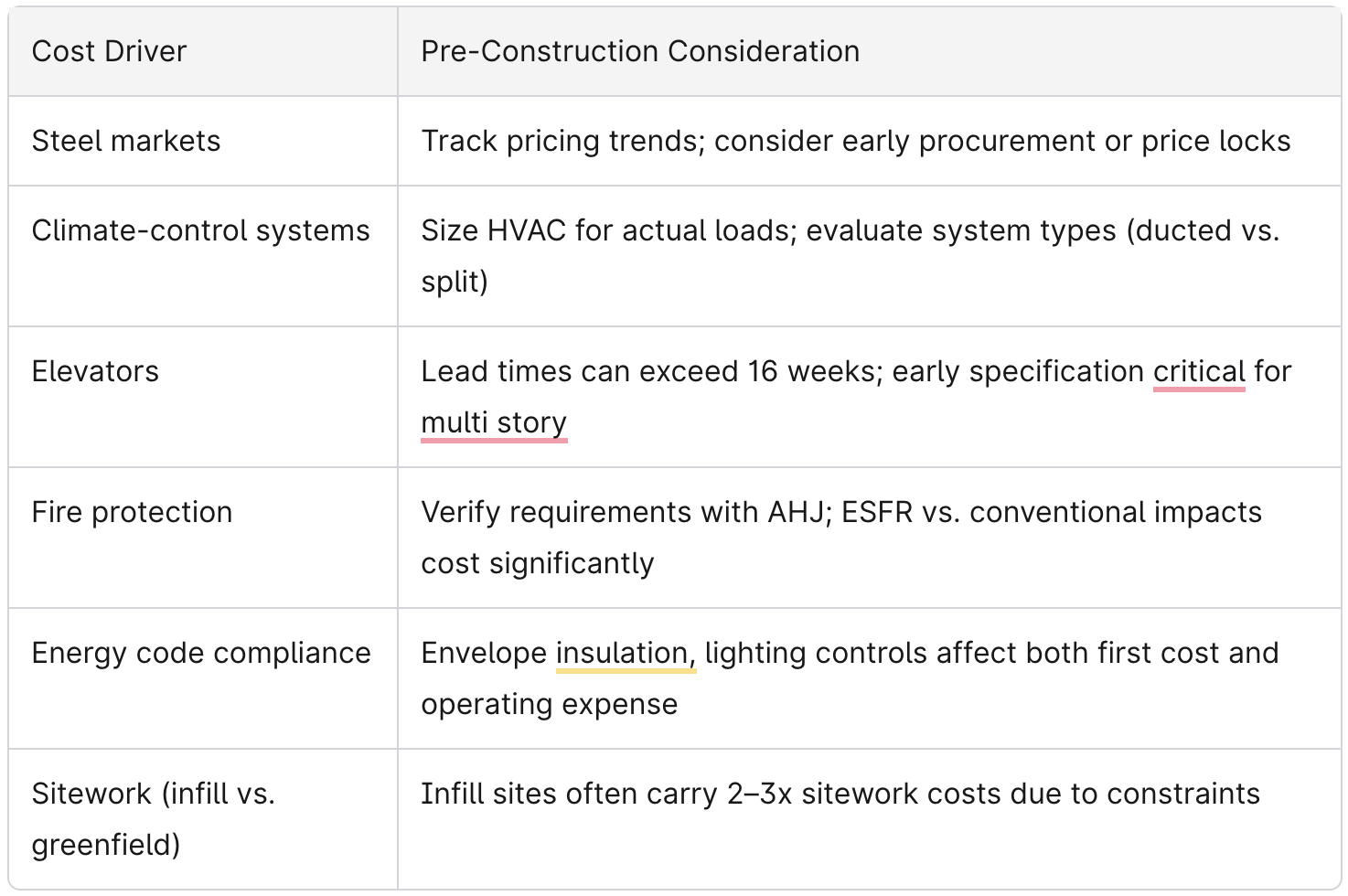
Scheduling and Timeline
Creating a realistic master schedule requires honest assessment of each phase:
Design: 2–4 months for schematic through construction documents
Entitlements: 6–12+ months depending on jurisdiction and complexity
Procurement: 8–16 weeks for key systems
Construction: 6–16 months depending on project size and complexity
Risk Factors and Mitigation Strategies
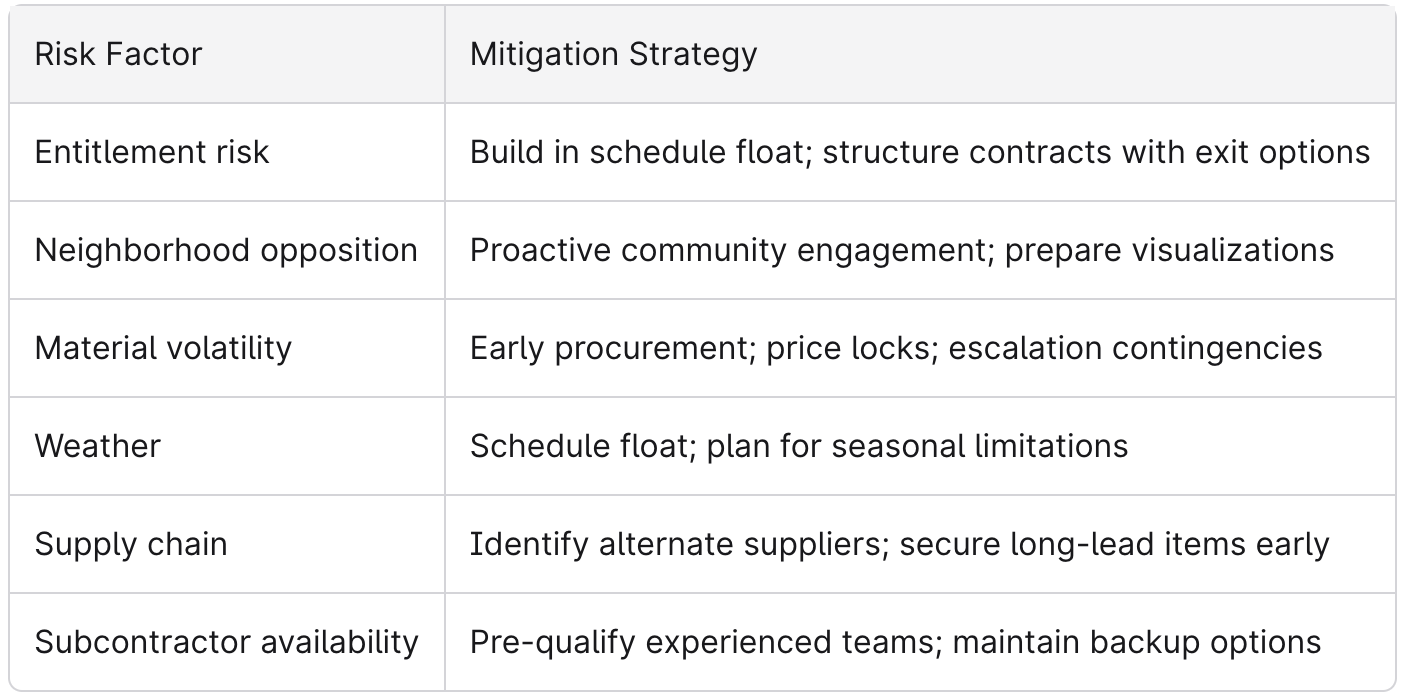
Owner-Level Controls
Owner-level controls ensure that pre-construction stays on track:
Monthly pre-construction reports summarizing progress, budget status, and risk updates
Milestone-based approvals gating progression from one phase to the next
Independent cost review for REIT investment committees before GMP commitment
Clear gating criteria that must be satisfied before issuing NTP
Design Standards, Brand, and Operational Considerations
Establishing Portfolio-Level Design Guidelines
Pre-construction is when REITs and developers should embed brand standards, ESG requirements, and operational considerations into the building design. Portfolio-level design guidelines should be established before project-specific design begins, addressing:
Façade expectations for urban versus suburban assets (material quality, transparency, articulation)
Signage criteria (size, placement, illumination)
Site and building lighting standards (security, energy efficiency, light pollution)
Minimum interior finish quality for corridors, elevators, and common areas, including interior finishes such as drywall, insulation, doors, and flooring
Color palettes and architectural vocabulary that reinforce brand recognition
Unit Mix and Operational Layout
Unit mix and operational layout decisions flow from market analysis into design. Considerations include:
Climate versus non-climate ratios to match local demand patterns
Drive-up versus interior access proportions
Loading bay locations, elevator count and placement for multi story buildings
Office and retail footprint
Back-of-house spaces for IT equipment, maintenance storage, and janitorial supplies
Technology Integration
Technology integration planned during pre-construction prevents costly retrofits. Work closely with your operations team to specify:
Access control systems (keypads, card readers, license plate recognition)
Smart locks enabling remote access and audit trails
CCTV coverage with sufficient camera density and recording capacity
Remote monitoring integration with central operations centers
Property-management software interfaces with physical systems
Low-voltage and data pathways coordinated with architectural and electrical design
Sustainability and ESG Considerations
Sustainability and ESG considerations increasingly matter for institutional storage assets. Features to consider:
LED lighting with occupancy sensors and daylight harvesting
Solar-ready roof structures and electrical infrastructure
EV charging conduit rough-ins
Low-water landscaping
Staffing and Operating Model Choices
All design decisions should connect to staffing and operating model choices:
Fully staffed facilities need larger offices and break areas
Hybrid operations balance on-site presence with remote monitoring
Unmanned facilities require robust kiosk capabilities, extensive CCTV coverage, and redundant access control
Pre-Opening, Turnover, and Handover Planning During Pre-Construction
Pre-Opening Planning Steps
REITs and developers should treat pre-opening planning as a formal workstream within pre-construction, starting 6–12 months before projected completion. Key steps include:
Commissioning: System verification and testing
Final Inspections: Ensuring code compliance and safety
Punch Lists: Identifying and correcting defects
Staff Training: Preparing the team for operations
Soft-Opening Activities: Controlled initial customer move-ins
Scheduling and Turnover Standards
Pre-construction schedules must incorporate realistic durations for pre-opening activities. Budget 4–8 weeks between substantial completion and grand opening. Turnover standards should be defined up front in construction contracts, including:
Acceptance criteria for life-safety systems
Access control testing
Elevator certification
Building automation system programming and verification
Documentation expectations (O&M manuals, as-built drawings, warranty certificates)
Marketing and Lease-Up Coordination
Aligning marketing and lease-up with construction requires coordination between development and operations teams:

Handover and Early Operations
A coordinated handover plan ensures a smooth transition:
Develop a soft-opening strategy for initial customers
Establish initial staffing levels appropriate for early occupancy
Conduct training on technology systems, security protocols, and customer service procedures
Create procedures for resolving first-30-day defects without disrupting tenants
Conclusion: The Value of Comprehensive Pre-Construction Planning
The time and resources invested in comprehensive self storage pre construction planning—from market analysis through handover procedures—determine whether your self storage project becomes a performing asset or an expensive lesson. Before approving your next new self storage facility investment, ensure every element of this pre-construction framework is documented, validated, and approved by your investment committee. The significant advantages of thorough planning compound throughout the project lifecycle, while shortcuts taken during pre-construction create problems that persist for years.