
A Comprehensive Guide to Self Storage Building in 2026
The self-storage industry continues to expand, with over 60,000 facilities across the United States generating more than $50 billion in annual revenue. If you’re considering developing a storage facility, one of the most critical decisions you’ll make is selecting the right self-storage builder. Before starting your self-storage business, it is essential to develop a comprehensive business plan and a strategic plan to evaluate market potential, outline project scope, and guide your operational and financial decisions.
This guide walks you through everything from initial feasibility to grand opening, helping you understand the construction process, evaluate contractors, and plan your budget effectively. Careful construction planning and understanding each step required for a successful self-storage facility build are crucial for ensuring your project's long-term success.
What Is a Self Storage Builder?
A self-storage builder is a contractor specializing in the design and construction of self-storage facilities, including multi-story climate-controlled projects, single-story drive-up units, mini storage buildings, and adaptive reuse conversions. Unlike general commercial contractors, these specialists understand the nuances of unit mix optimization, corridor configurations, load requirements, security integration, and storage-specific building codes, much like a dedicated storage building company for multi-level self-storage construction.
In 2026, many self-storage builders operate as design-build or turnkey partners. They handle the full scope of development—from site planning and engineering through fabrication, erection, and final commissioning. This integrated approach helps streamline timelines and reduce the disconnects that often plague projects using traditional delivery methods.
The facility types these builders construct include:
Single-story drive-up units — Low-cost per square foot, relying on vehicle access with minimal internal corridors
Multi-story climate-controlled buildings — Common in urban infill locations, featuring elevators, enhanced insulation, and HVAC systems
Boat & RV storage — Open yards or partially enclosed canopies with wider aisles and heavier pavement
Adaptive reuse conversions — Transforming warehouses or big-box retail into storage, particularly in dense areas where land costs are prohibitive
Mini storage buildings — Versatile and customizable solutions, mini storage buildings can be developed to meet a variety of storage needs and adapted for different locations
A self-storage builder differs from a generic commercial contractor through specialized expertise:
Familiarity with unit mix strategies and how layout affects rentable square feet
Deep knowledge of door systems, including roll-up configurations and insulation options
Understanding of climate control requirements for envelope design and humidity management
Experience integrating security systems, gate access, and network infrastructure
Navigation of local zoning and storage-specific entitlements
Self-storage builders can develop tailored solutions for different locations and discuss project requirements with clients to ensure each facility meets specific operational and market needs.
Why Self Storage Construction Is a Strong Investment in 2026
The U.S. self-storage market includes approximately 60,000 to 63,000 facilities with over 2 billion net rentable square feet. Industry revenue exceeds $50 billion annually, and household penetration sits at roughly 11-13%, with usage continuing to climb. Markets in California, Texas, Florida, Arizona, and major metropolitan areas show particularly strong demand.
Self-storage is a growing business opportunity, and evaluating the business potential and financial returns is essential before developing or expanding a facility. Several factors drive this demand. Apartment living continues to expand, and smaller living spaces mean tenants need external storage. E-commerce growth has created demand from small businesses needing inventory space. Relocation patterns since 2020 have increased mobility and temporary storage needs. In hot, humid, or cold climates, climate-controlled self-storage facilities command premium rates and are typically included in the ideal unit mix for maximizing revenue, as customers seek protection for furniture, electronics, and documents.
From a financial perspective, self-storage offers relatively low operating costs compared to office or retail properties. Staffing requirements are minimal, utility loads for non-climate units are modest, and month-to-month leases create flexibility. Tenant stickiness tends to be strong once units are occupied. Revenue per available square foot nationally averages $14-17 per year, with top facilities in prime markets achieving $22-30 or more. Institutional operators maintain occupancy rates around 92%, while the overall industry average hovers near 82%.
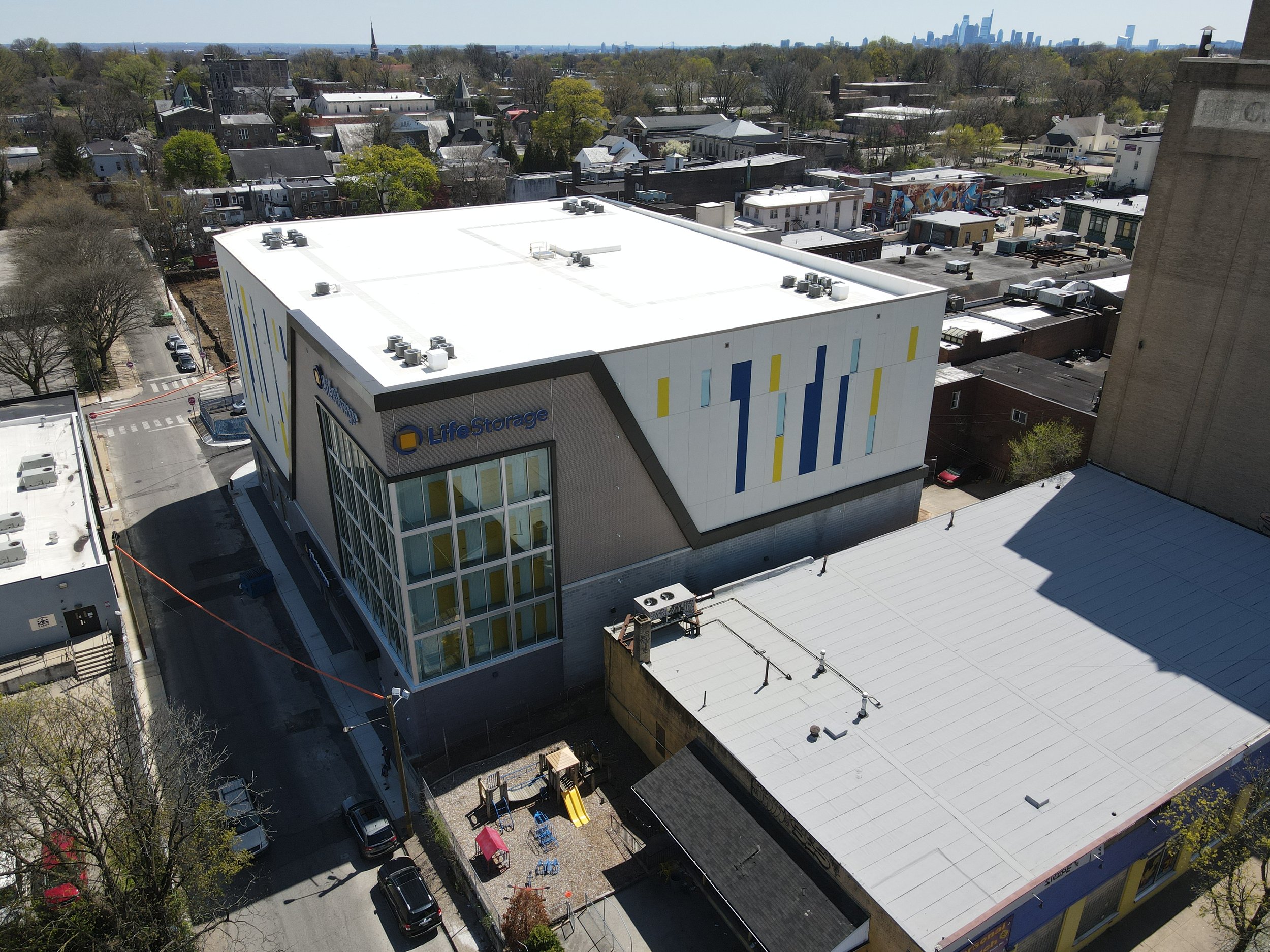
Well-located facilities built since around 2018 increasingly incorporate climate control, elevators, high-end lobbies, and branded exteriors. These features help differentiate in competitive markets and justify higher rental rates. Developers seek specialized self-storage builders to:
Optimize floor plans and unit mix to maximize rentable square footage
Manage cost volatility in materials like steel, doors, and HVAC equipment
Meet increasingly strict building codes and design standards
Accelerate timelines through design-build delivery
Ensure quality in critical systems that affect long-term performance
The Self Storage Construction Process: From Concept to Grand Opening
The self-storage construction process typically takes 12 to 24 months, with 6 to 16 months dedicated to actual construction. Building a self-storage facility follows a phased process, and using an experienced self-storage builder streamlines each step while reducing costly missteps. Timelines for a new ground-up facility typically range from 12 to 24 months, depending on entitlement complexity, site conditions, and whether the project is single-story or multi-story.
The five key phases of building a self-storage facility are: Planning and Feasibility, Design and Permitting, Financing, Construction, and Marketing and Opening.
Consider a hypothetical self-storage project: a 90,000 to 120,000 net rentable square foot multi-story climate-controlled facility on a 2-3 acre urban infill site. This project would require allocation for lobby space, elevators, parking, and site access. Planning and entitlement might take 6-12 months, construction another 12-16 months, and commissioning runs concurrently with the final construction phases. Pre-leasing often begins several weeks before completion to accelerate cash flow.
The construction process breaks into distinct phases: market feasibility and site selection, preconstruction planning, design, permitting, construction and fit-out, and commissioning. Construction planning involves defining what actions need to be completed, creating an ordered timeline of events, staffing the project, and determining the necessary materials and equipment. Developing a construction plan is a critical task in the management of construction, even if the plan is not written or otherwise formally recorded. A construction plan is the central pillar for monitoring and evaluating all project activities. Identifying key resources and breaking down resource requirements is crucial for effective construction planning. Resource planning, creating a detailed plan for staff, materials, and budget, ensures that each project has the necessary resources for successful and timely completion. Breaking down main activities into sub-activities helps facilitate scheduling, resource allocation, and project control. Effective construction planning can increase a team's productivity and efficiency by streamlining communication. It is important to determine the steps required for each phase and the overall course of the project to ensure timely completion and resource efficiency. Each phase builds on the previous one, and skipping steps or rushing decisions typically creates problems that cost more to fix later.
1. Market Feasibility and Site Selection
Before hiring a self-storage builder, owners typically commission a feasibility study covering supply and demand within a 3-5 mile radius. These studies analyze competing inventory, occupancy rates, rental rate trends, absorption patterns, demographic data, traffic counts, and land values. The goal is to validate whether the market can support new self-storage space at rates that make the project financially viable and fit into an overall plan for starting a self-storage business. It is also essential to determine if both the market and the specific site are suitable for a new self-storage facility before proceeding.
Ideal site characteristics in 2026 include high vehicle traffic (often 20,000 or more vehicles per day on nearby thoroughfares), strong visibility from main roads, proximity to residential rooftops, easy ingress and egress, and accessible utilities. Urban sites may be smaller but more vertical, while suburban sites typically range from 2-5 acres for single-story drive-up facilities. Multi-story climate-controlled projects can work on 1-3 acres using structured layouts and elevators to maximize density.
An experienced builder can review early concept plans for constructability and provide rough order-of-magnitude costs to validate your initial plan, so it is often worth contacting a turnkey self-storage construction company early in the process. Key site evaluation factors include:
Visibility and road frontage
Traffic counts and access points
Zoning status and allowed height/FAR
Soil and geotechnical conditions
Water drainage and stormwater requirements
Proximity to utilities and cost of connections
Local competitive supply and demographics
Regulatory constraints like floodplains or environmental issues
2. Preconstruction Planning and Budgeting
Preconstruction is the phase where the self-storage builder collaborates with the owner and design team to refine scope, schedule, and budget before breaking ground. This is where critical decisions get made about unit mix, structural systems, and mechanical specifications. During this stage, it is essential to identify resource requirements and begin resource planning, creating a detailed plan that outlines the necessary staff, materials, and budget for each project activity. Construction planning should include a detailed breakdown of the resources needed for the project to ensure effective scheduling, budgeting, and project completion.
Specific tasks include preliminary unit mix planning (determining the balance of 5x5, 10x10, 10x20, and larger units based on market demand), structural system selection (pre-engineered metal versus structural steel with cold-formed framing), and initial civil and MEP coordination. Builders provide conceptual estimates based on cost per gross square foot. In 2026, typical ranges include $25-35 per square foot for single-story drive-up non-climate facilities and $45-70 or more per square foot for climate-controlled multi-story buildings, though exact numbers vary significantly by region.
Given volatility in steel and mechanical equipment costs, early budgeting and value engineering are especially important. Builders often draw on self-storage construction resources about structural systems and design tools to identify alternatives that reduce costs without compromising rentability—optimizing structural spans, standardizing door sizes, or adjusting insulation specifications.
Key documents produced during preconstruction include:
Concept site plan and building footprint
Preliminary unit mix plan
Preliminary construction plan and schedule with major phases
ROM budget with line-item breakouts
Phasing strategy for multi-building projects
Site survey and geotechnical report
3. Designing a Modern Self-Storage Facility
Self-storage builders typically work closely with architects and engineers who specialize in storage layouts. The goal is to optimize rentable square footage while creating a positive customer experience. Design decisions made early have lasting impacts on revenue potential and operating costs.
Unit mix strategy depends on local demographics and competition. Many recent projects use a distribution of approximately 30% smaller units (5x5, 5x10), 50% medium units (10x10, 10x15), and 20% larger units (10x20 and up). Corridor widths must accommodate customers with carts and dollies while not wasting valuable space. Elevator count and placement affect customer convenience and construction costs. Stairwells must meet fire and life safety codes while minimizing footprint.
Multi-story climate-controlled facilities require robust HVAC systems, well-insulated wall and roof assemblies, and carefully sealed building envelopes to maintain temperature and humidity ranges, and developers should carefully evaluate the key considerations in building climate-controlled self-storage to balance energy efficiency with tenant comfort. Exterior design trends since 2020 emphasize glass at building corners, branded color schemes, architectural metal panels, and signage that meets municipal design guidelines. The purely industrial aesthetic is increasingly unacceptable in suburban and regulated urban areas.
Specific choices a builder advises on include:
Structural system (metal, steel frame, or hybrid)
Building skin and envelope materials
Corridor layout and widths
Elevator location and quantity
Door types and sizes
Interior partition systems
Mechanical system layout
Finish levels for corridors and lobbies
4. Permitting and Approvals
Self-storage projects must secure zoning approvals, site plan approvals, building permits, and sometimes special use permits—especially in municipalities that classify storage as a conditional use. The permitting process involves coordination with planning departments, fire marshals, and building officials. Timelines can range from a few months to over a year, depending on jurisdiction complexity.
Experienced self-storage builders understand common municipal concerns: traffic impact, building aesthetics, stormwater management, and neighborhood compatibility. They help assemble drawings, studies, and presentations that address these concerns proactively rather than reactively.
Key permit packages typically include:
Civil/site permits (grading, utilities, stormwater, paving)
Architectural permits (elevations, façades, entry design)
Structural permits (foundations, frames, roof structure)
MEP permits (mechanical, electrical, plumbing, HVAC)
Fire protection and life safety permits
Environmental or stormwater management submittals
5. Construction and Fit-Out
The construction phase moves through several stages: sitework and utilities, foundations and slab, structural frame and roofing, exterior envelope, interior partitions and corridors, MEP rough-in and finishes, and final punch list. Each stage requires coordination among the construction team and various subcontractors.
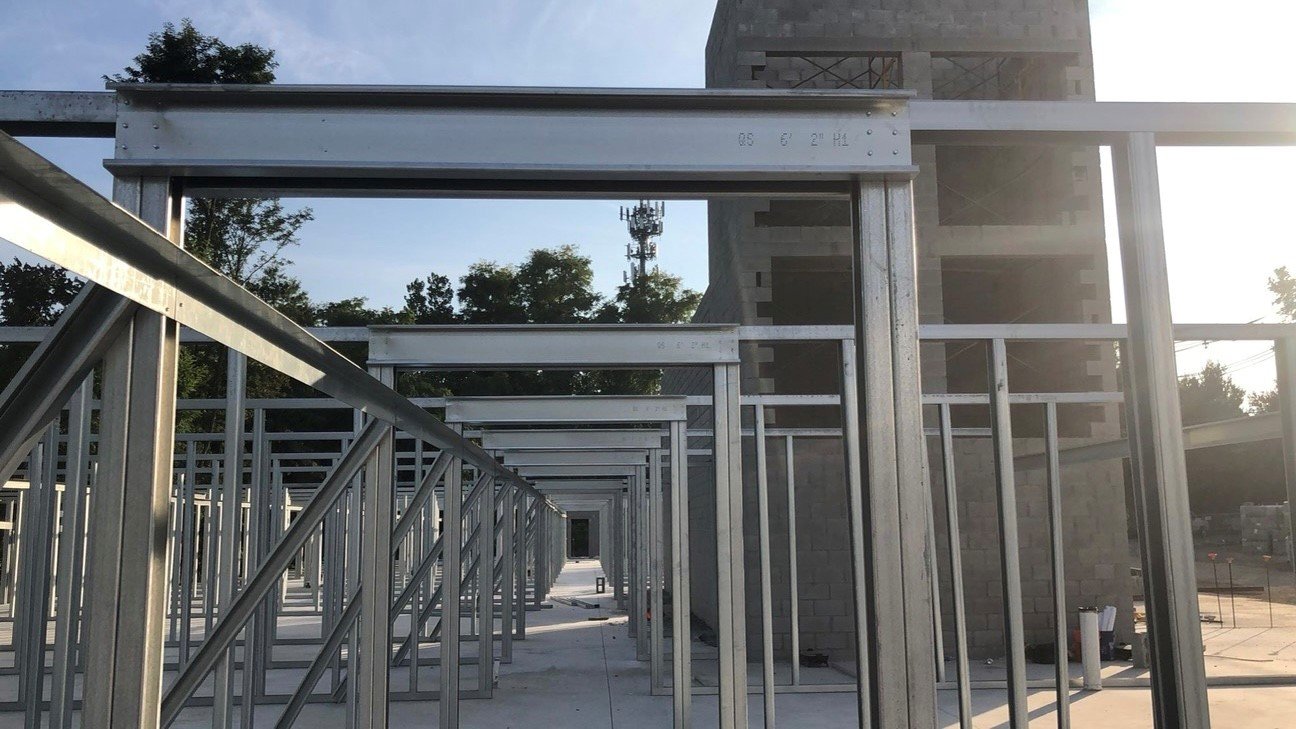
Self-storage-specific elements include pre-engineered metal building systems or hybrid systems, roll-up door installation, hallway systems with metal or sheet steel partitions, and elevator installation for multi-story projects. Typical durations range from 8-14 months for single-story drive-up projects to 12-18 months or longer for multi-story climate-controlled facilities, with variations based on weather, procurement lead times, and site complexity.
A specialized builder sequences work tasks to protect doors, finishes, and security systems from damage during construction. Procurement lead times for structural steel, doors, HVAC equipment, and elevators require careful planning to avoid delays.
Critical milestones owners should track with their builder:
Steel delivery and erection completion
Dry-in (weather-proof envelope closed)
First usable floor or building turnover
HVAC and climate control system start-up
Elevator testing and safety inspections
Security hardware and gate installation
6. Commissioning, Inspections, and Opening
The final stages include inspections by building officials and fire marshals, system commissioning (HVAC balancing for climate control, access control, and camera testing, elevator inspections), and a certificate of occupancy. The builder coordinates training for the owner’s operations team on fire alarm systems, security software, and building maintenance procedures. Many developers begin pre-leasing several weeks to months before completion, so the builder may sequence areas to be turned over early for marketing purposes.
Items an owner should verify before final acceptance:
As-built drawings documenting actual construction
Operations and maintenance manuals
Warranties for structural, mechanical, envelope, and door systems
Completion of all punch list items
Test reports from HVAC, elevator, and security systems
Certificate of occupancy
All utility hookups confirmed and operational
Multi-Story Climate-Controlled Self Storage Facilities
Multi-story climate-controlled facilities have become common in dense areas and markets with extreme temperatures—Texas, Florida, Arizona, and major coastal metros all see significant development of this building type. Vertical construction allows higher rentable square footage on smaller or more expensive parcels, improving project feasibility where land costs are high.
Specialized self-storage builders bring proven prototypes and best practices for elevator placement, structural grids, and mechanical zoning. These elements affect both construction costs and ongoing operational efficiency, making experience in this particular project type valuable when choosing a multi-level self-storage construction partner.
Structural and Building Systems Considerations
Multi-story storage buildings typically use structural steel frames with concrete slabs on metal deck, or hybrid systems integrating pre-engineered components with conventional steel. Live load design for storage is heavier than office occupancy—builders and structural engineers typically assume 125 pounds per square foot or more to accommodate heavy stored goods.
Building envelope details matter significantly for climate control. Insulated wall panels, appropriate roof insulation values, vapor barriers, and attention to air sealing all reduce long-term energy costs. Thermal bridging at structural connections can create condensation problems if not properly addressed.
A builder evaluates several specific factors:
Column spacing and its impact on unit layout flexibility
Floor-to-floor heights accommodating ceiling ductwork
Loading dock design and placement
Slab flatness in corridors for carts and dollies
Elevator shaft structural requirements
Roof load capacity for HVAC equipment
Mechanical, Electrical, and Climate Control
Typical HVAC strategies for multi-story storage include distributed rooftop units, split systems, or variable refrigerant flow (VRF) systems zoned by floor or building wing. Zoning allows efficient operation and better humidity control. Target temperature ranges typically fall between 55-80°F, depending on regional climate, with relative humidity maintained at 50-60% to protect stored goods.
Electrical systems must support HVAC loads, lighting, elevator operation, access control, and camera systems. Backup power requirements depend on local codes and owner preferences—many facilities include generators or UPS systems for critical functions like gate entry and elevator safety.
Coordination needs between the builder, MEP engineer, and security integrator include:
Electrical capacity sizing for all building systems
Conduit routing for security and network infrastructure
Space allocation for mechanical rooms and network closets
HVAC equipment placement on the roof or in mechanical spaces
Backup power scope and integration
Elevators, Access, and Internal Circulation
The number and placement of freight and passenger elevators significantly affect customer satisfaction, construction cost, and rentable efficiency. Elevator lobbies should be sized for carts, with durable flooring and wall protection to handle the traffic. Clear sightlines improve safety perception for customers.
Experienced builders reference the performance of past projects to advise on the appropriate elevator count for a given square footage and unit distribution per floor. Too few elevators create customer frustration; too many reduce rentable space unnecessarily.
Circulation design considerations include:
Stair placement meeting code while minimizing footprint
Corridor widths (typically 8-12 feet for climate-controlled hallways)
Turning radii at corners for moving carts and furniture
Signage and wayfinding for clear navigation
Lighting levels for safety and security perception
Key Features to Include in a Modern Self-Storage Facility
Beyond structure and layout, modern storage facilities compete on security, convenience, digital integration, and aesthetics. A self-storage builder with recent project activities can recommend which features meaningfully improve lease-up and customer satisfaction, given your total budget constraints.
Security and Access Control
Security systems have become increasingly sophisticated. Common installations include perimeter fencing, motorized gates with keypad or mobile app access, individual unit alarms, high-definition CCTV with cloud recording, and intercoms. Builders coordinate rough-ins for cameras, card readers, and conduit pathways, working with specialized security vendors.

Technologies widely adopted since around 2022 include Bluetooth or smartphone-based access that eliminates physical keys, license plate recognition at gates for enhanced security and convenience, and integrated management platforms connecting access control, billing, and unit status in a single system.
Security design priorities include:
Complete coverage of entrances, parking, gates, and interior hallways
Redundancy in recording and access systems
Lighting coordination with camera placement
Secure network design for connected devices
Backup power for critical security functions
Customer Convenience and Accessibility
Features that enhance convenience include covered loading bays protecting customers from the weather, wide drive aisles accommodating various vehicle sizes, cart storage near entrances, automatic doors where appropriate, and ADA-compliant access throughout the facility.
Vehicle circulation and parking design becomes particularly important for facilities serving trucks, trailers, boats, and RVs. These customers need larger turning radii, heavier pavement, and appropriately sized doors.
Design touches that improve customer experience:
Clean, well-maintained restrooms
Office layout with retail area for packing supplies
Clear directional signage inside and outside
Adequate lighting throughout the facility
Landscaping that enhances curb appeal
Technology and Facility Management
Many facilities now integrate online leasing, digital kiosks, and management software, connecting access control, billing, and unit status. This technology improves operational efficiency and customer convenience while providing better data for rate management.
A builder plans for data rooms, network infrastructure, and conduit to support current and future technology upgrades. Coordination points include:
IT rough-ins throughout the building
Wi-Fi coverage in hallways, offices, and common areas
Space allocation for servers, UPS, and network equipment
Conduit capacity for future technology additions
Integration planning between building systems and management software
Finishes, Branding, and Curb Appeal
The shift since around 2018 toward “retail-quality” exterior design means attractive façades, glazing, and branded color schemes rather than purely industrial aesthetics. Municipal design guidelines often require certain materials, landscaping, and architectural treatments that affect both appearance and cost.
A self-storage builder helps balance cost and durability when selecting finishes for high-traffic corridors, doors, and lobbies. Materials needed include options that resist damage from carts and moving activities while maintaining appearance over time.
Exterior and interior finish priorities:
Long-life materials like metal panels, fiber cement, and masonry accents
Branded signage meeting size and placement requirements
Landscape integration softening building mass
Night lighting enhances security and visibility
Durable corridor finishes are easy to clean and maintain
How to Choose the Right Self Storage Construction Contractor
Selecting the right self-storage construction contractor is one of the most consequential decisions in your development process. Construction of a storage facility is specialized work, and owners should vet contractors for relevant experience, financial strength, and process discipline before signing contracts, keeping in mind key things to consider before hiring a self-storage construction company.
Experience With Self Storage and Project Types
Review the contractor’s portfolio for completed self-storage facilities, ideally within the last 5-10 years, and of similar size and complexity to your planned project. Exploring completed multi-level self-storage projects can also reveal how a builder handles climate-controlled designs, site constraints, and aesthetic requirements. If you’re building a multi-story climate-controlled facility, conversion project, or boat and RV storage, look for specific experience with that project type.
Ask for references from owners of projects delivered between 2019 and 2025 to understand how the builder performed through recent market conditions, including materials volatility and labor challenges.
Questions to ask about past self-storage work:
How did actual schedules compare to original projections?
Were projects completed within budget, and how were overruns handled?
What post-completion support was provided?
How did the builder handle unexpected issues during construction?
Would the owner use this builder again?
Licensing, Insurance, and Geographic Capability
Verify that the contractor holds appropriate licenses in your project’s state and has adequate insurance coverage. This includes general liability, workers’ compensation, and builder’s risk insurance. Many self-storage builders are licensed in multiple states and can handle projects in different locations, making them suitable for regional or national rollouts. However, local code familiarity remains essential to ensure compliance with specific requirements at each site.
Documentation owners should request:
Current state contractor license copies
Insurance certificates showing coverage limits
Bonding capacity letters
References verifiable in your geographic area
Evidence of relationships with local jurisdictions
Design-Build vs. Traditional Delivery
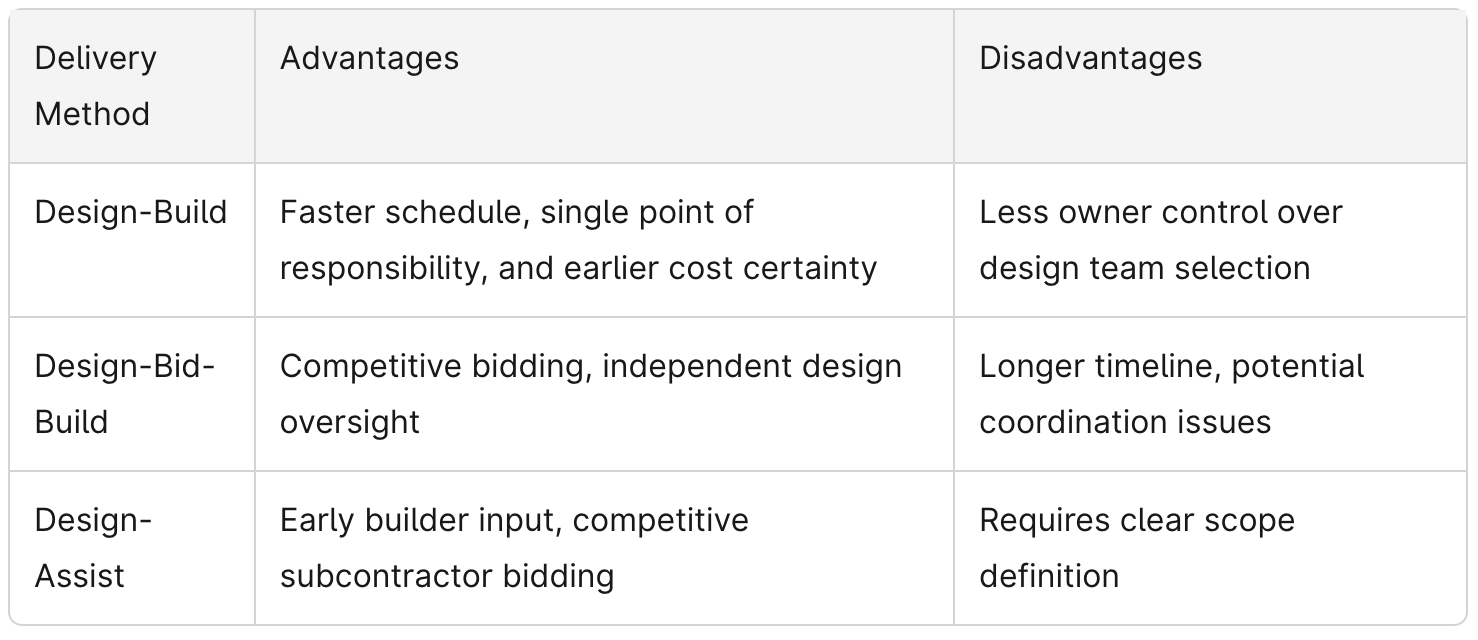
Design-build delivery involves a single contract with one firm managing both design and construction. This approach can shorten schedules, improve coordination, and provide earlier cost certainty. The trade-off is less owner control over architect and engineer selection.
Traditional design-bid-build approaches allow owners to hire their own design team, produce complete documents, and then competitively bid for construction. This can yield competitive pricing but tends to take longer and creates potential disconnects between design intent and construction execution.
Many self-storage builders offer design-assist or hybrid services that capture the benefits of both approaches:
Preconstruction Services and Value Engineering
Robust preconstruction services add significant value. Constructability reviews catch problems before they become expensive change orders. Alternative material evaluations identify cost-effective options. Design suggestions can preserve rentability while reducing costs.
Ask builders for examples of how they reduced costs or improved performance on recent self-storage projects. Common value engineering areas include optimizing structural spans, selecting efficient HVAC configurations, standardizing door sizes, and adjusting insulation specifications.
Preconstruction deliverables owners should expect:
Constructability review with specific recommendations
Option studies comparing different approaches
ROM budget with clear assumptions
Preliminary schedule with realistic milestones
Value engineering suggestions with cost/benefit analysis
Transparency in Pricing and Scheduling
Request detailed estimates with line items for sitework, building shell, interior systems, security, and contingencies. Vague or bundled pricing makes it difficult to evaluate proposals and track costs during construction.
Schedules should reflect realistic permitting timelines, procurement lead times (especially for steel, elevators, and HVAC), and weather considerations. Proposals should clearly define:
Assumptions about site conditions, scope, and specifications
Allowances for items not yet fully specified
Exclusions that the owner must provide or contract separately
Escalation clauses or material price protections
Payment terms and milestone-based billing
Communication, Project Management, and Reporting
An organized self-storage builder uses project management tools, regular meetings, and progress reports to keep owners informed. The project manager assigned to your job should have direct experience with self-storage construction, not just general commercial work.
Assess proposed communication practices before signing contracts:
Frequency and format of progress updates (weekly meetings, monthly reports)
Cost reporting structure and change order procedures
Point of contact hierarchy and escalation process
Document management and photo documentation practices
Decision timeline expectations from the owner
Cost Drivers and Budget Planning for Self Storage Projects
Budget planning for self-storage is a collaboration between owner, feasibility consultant, and builder. Understanding the total cost is a key part of budget planning, as it allows you to estimate and monitor project resources, plan cash flow, and compare actual expenditures with estimates to identify potential issues. Costs vary significantly by region and project type, and understanding what drives those costs helps you make informed decisions about scope and specifications.
Common construction costs range from $45 to $130+ per square foot, depending on the facility's design and number of stories.
Land, Sitework, and Civil Infrastructure
Land often represents 25-35% of total development cost for many ground-up projects, with higher percentages in dense urban areas where competition for suitable parcels is intense. Sitework costs depend heavily on existing conditions: topography requiring significant grading, poor soils needing remediation, utility availability, and stormwater requirements all impact the estimate.
Typical sitework items to budget include:
Grading and earthwork
Utility connections (water, sewer, electric, gas)
Paving and drive aisles
Retaining walls where grade changes require
Stormwater detention or retention facilities
Perimeter fencing and gate infrastructure
Landscaping and irrigation
Building Shell, Interiors, and Climate Control
Structural system selection is a major cost driver. Single-story pre-engineered metal buildings cost less per square foot than multi-story structural steel with concrete decks. The choice depends on site constraints, required density, and whether climate control is planned.
Climate control systems add significant cost—typically $8-15 per square foot for HVAC, insulation upgrades, and enhanced envelope. Higher-quality doors, better interior finishes like polished concrete floors, and durable wall systems also increase costs but may improve lease-up speed and rental rates.
Value engineering focus areas for managing costs:
Structural span optimization, reducing steel tonnage
HVAC zoning matched to actual occupancy patterns
Standardized door sizes reduce custom fabrication
Insulation specifications balancing performance and cost
Interior finish levels appropriate to market positioning
Soft Costs, Financing, and Contingencies
Typical soft costs include architectural and engineering fees, surveys, geotechnical reports, legal fees, permit and impact fees, and financing costs. These often run 8-12% of total project cost but can be higher in complex jurisdictions requiring extensive studies and approvals.
Construction contingencies are essential given material price fluctuations and potential code-related changes during design and permitting. With the volatility experienced in recent years, many developers maintain 10% hard cost contingency.
Contingency planning considerations:
Hard cost contingency of 10% or more, depending on project complexity
Schedule contingency for permitting and weather delays
Material escalation protection through contract terms or allowances
Code change contingency for projects with long approval timelines
Discussion with the lender about contingency requirements for financing
Conversions, Expansions, and Specialty Self Storage Projects
Not all self-storage projects are greenfield development. Many investors pursue conversions of existing buildings or expansions of operating sites. Conversions and expansions are effective strategies to grow a mini storage business, allowing owners to maximize property value and adapt to changing market demands. A self-storage builder experienced in these project types can navigate unique code issues, structural modifications, and phasing challenges.
When evaluating conversion candidates, many existing structures—such as warehouses or retail spaces—are often repurposed for mini storage use due to their adaptable layouts and cost efficiency, and working with experts in self-storage conversions and retrofits can streamline this process.
Converting Existing Buildings to Self Storage
Common conversion candidates include vacant big-box retail (former grocery, home improvement, or department stores), warehouses, and industrial buildings. These buildings often have good locations, high visibility, and adequate parking—but require significant modification to function as self-storage.
Key technical issues in conversions include structural modifications to support new loads, adding elevators and egress where needed, fire separation requirements, new mechanical systems, and façade updates meeting zoning and branding needs. Environmental issues may arise if the previous use involved hazardous materials.
A builder assesses building suitability by evaluating:
Clear heights and whether they support mezzanines or multi-level construction
Column spacing and impact on unit layout efficiency
Structural condition and capacity for new loads
Existing mechanical, electrical, and plumbing systems
Roof condition and remaining useful life
Code compliance gaps requiring upgrades
Expansions and Phased Construction
Owners often add additional buildings or floors to successful facilities, requiring careful coordination around ongoing operations and tenant safety. The construction team must maintain access for existing customers while developing new sections.
Phasing considerations include:
Temporary fencing separates construction from operational areas
Revised traffic patterns maintain customer access
Communication with existing tenants about the construction schedule and impacts
Utility modifications avoiding service interruptions
Permit requirements for expansion phases
Coordination with ongoing facility management
Boat, RV, and Specialty Storage
Boat and RV storage requires design modifications from standard self-storage: wider drive aisles, larger door heights, canopies or partially enclosed units, and heavier pavement sections to support vehicle weights. Electrical provisions for trickle charging, enhanced site lighting, and drainage considerations for wash areas may be required.
Questions owners should ask builders about specialty storage:
What pavement thickness and design is appropriate for expected vehicle weights?
What door and entry heights accommodate boats, RVs, and trailers?
How should electrical infrastructure support charging requirements?
What drainage slope and capacity handles wash-down activities?
What security configurations work for large outdoor vehicle storage?
What setbacks and permits apply to large vehicle storage in this jurisdiction?
Working With a Self Storage Builder in 2026: Next Steps
Selecting a specialized self-storage builder who understands current market conditions, codes, and design trends is fundamental to project success. The right builder brings experience that helps you avoid costly mistakes, identify opportunities for value engineering, and complete your project on schedule.
Before approaching contractors, prepare a clear project brief covering your target market (residential consumers, commercial users, or mixed), preferred location characteristics, target size in rentable square feet, budget range, and timeline expectations. It is also essential to develop a comprehensive business plan that outlines your project scope, communicates your goals, and serves as a guideline for both you and potential builders throughout the development process. This information allows builders to provide meaningful responses rather than generic proposals.
The development process starts with validation—confirming that your market can support new supply at rates making your project financially viable. From there, selecting the right self-storage builder and working through preconstruction establishes the foundation for success.
Action items to move from research into planning:
Define project parameters: target market, size, unit mix, climate control requirements, and number of stories
Commission a feasibility study analyzing supply, demand, competitor rates, and absorption
Identify potential sites by evaluating land cost, utilities, zoning, and traffic
Compile a shortlist of builders with demonstrated experience in similar projects
Request proposals including ROM budget, schedule, and key assumptions
Validate builder licensing, insurance, bonding, and references
Plan for permitting timeline and environmental constraints
Build contingency into both the budget and the schedule for materials and approval delays
Project Management for Self Storage Construction
Effective project management is the backbone of any successful self-storage construction project. A skilled project manager oversees the entire construction process, ensuring that every phase—from initial planning to final completion—runs smoothly and efficiently. This role involves close coordination with the construction team, engineers, architects, and other stakeholders to keep the self-storage project on track.
For self-storage construction, project management means more than just tracking timelines. It requires a deep understanding of the unique requirements of storage construction, including unit mix, security systems, and climate control. The project manager is responsible for developing a detailed construction plan, setting clear milestones, and monitoring progress to ensure that the project stays within budget and meets quality standards.
Throughout the construction process, the project manager facilitates communication between all parties, resolves issues as they arise, and adapts the plan to address unforeseen challenges. By maintaining rigorous oversight and fostering collaboration among the construction team, engineers, and subcontractors, the project manager helps ensure that the self-storage facility is completed on schedule, within budget, and to the highest standards of quality. This level of project management is essential for minimizing delays, controlling costs, and delivering a storage facility that meets both client expectations and industry benchmarks.
Resource Planning for Self Storage Projects
Resource planning is a critical step in the development of high-quality storage facilities. For self-storage construction projects, resource planning involves identifying all the materials, labor, and equipment required to complete the project efficiently and cost-effectively. A well-developed resource plan ensures that every aspect of the project is accounted for, from the initial site work to the final installation of storage units.
The process begins with a thorough assessment of the project’s scope and requirements. This includes determining the types and quantities of materials needed, scheduling labor resources, and securing the necessary equipment. By creating a detailed schedule and budget, project managers can anticipate potential bottlenecks and allocate resources where they are needed most.
Resource planning also involves risk management—identifying possible challenges that could impact the construction timeline or budget, and developing strategies to mitigate these risks. This proactive approach helps prevent delays and cost overruns, ensuring that the self-storage construction project is completed on time and within budget.
Ultimately, effective resource planning leads to more efficient construction projects, higher-quality storage facilities, and greater client satisfaction. By carefully managing resources throughout the development process, self-storage builders can deliver completed projects that meet or exceed client expectations.
Cost Efficient Construction Methods for Self Storage
Adopting cost-efficient construction methods is essential for maximizing the profitability of self-storage facilities. One of the most effective strategies is the use of pre-engineered metal buildings, which can be custom-designed to fit the specific needs of each project. These structures are not only more affordable than traditional construction methods, but they also allow for faster assembly, reducing labor costs and minimizing the risk of project delays.
In addition to pre-engineered solutions, selecting materials and designs optimized for self-storage facilities can further enhance cost efficiency. For example, incorporating climate-controlled units and advanced security systems can increase the value of the facility while keeping operational costs manageable. Choosing durable, low-maintenance materials ensures long-term performance and reduces future repair expenses.
By focusing on cost-efficient construction methods and materials, self-storage construction projects can be completed at a lower overall cost without sacrificing quality. This approach benefits clients by delivering high-quality, custom-designed storage facilities that offer strong returns on investment and meet the evolving needs of the market.
Overcoming Common Challenges in Self Storage Construction
Self-storage construction projects often present unique challenges that require careful planning and expert execution. One of the most common hurdles is ensuring that the self-storage facility is completed on time and within the established budget. Achieving this requires a robust project plan, effective project management, and seamless coordination among the construction team, engineers, and other stakeholders.
Another significant challenge is designing a storage facility that meets the specific needs of clients and the demands of the local market. This involves thorough site planning, understanding customer requirements, and selecting the right materials and construction methods to ensure long term performance and operational efficiency.
To overcome these challenges, it is essential to work with experienced self-storage construction professionals who understand the intricacies of storage construction. Utilizing proven construction methods, conducting comprehensive site planning, and establishing a detailed project plan and budget can help mitigate risks and ensure the success of the project. By prioritizing communication, collaboration, and proactive problem-solving, clients can achieve a completed self-storage facility that delivers lasting value and meets the highest standards of quality and performance.