
Self Storage Construction Company: How Institutional Investors Should Choose a Multi‑Story Partner
Key Takeways
This guide is for developers and REITs evaluating a self-storage construction company for multi-story, climate-controlled assets.
A specialized self-storage builder reduces scope gaps, change orders, and schedule risk compared with a generic self-storage contractor.
Storage Building Company focuses nationwide on multi-level self-storage construction, integrating design, engineering services, fabrication, and installation.
The most cost-efficient path is early preconstruction planning, which includes creating a detailed plan for development strategies, site layouts, and construction workflows to ensure efficient and successful self-storage facility projects.
Schedule a preconstruction review with Storage Building Company before you break ground.
Introduction: Why Multi‑Story Self Storage Requires a Specialized Construction Company
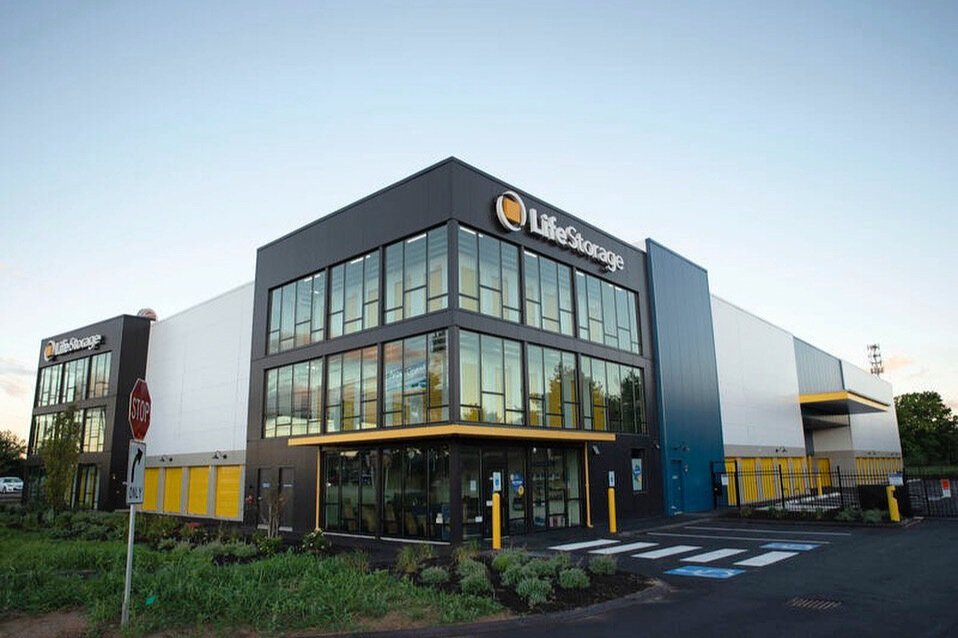
Investor demand remains strong: U.S. self-storage transaction volume reached about $2.85B in H1 2025, according to Cushman & Wakefield, while urban infill sites keep pushing developers upward. A multi-story storage facility is not a warehouse with doors; it combines unit mix, elevators, fire/life safety, security systems, climate control, traffic flow, and retail-like customer access.
Typical institutional storage projects are 80,000–140,000+ rentable square feet, 3–5 stories, often on 1.5–3.0 acres. The best sites for self-storage facilities are located at major intersections that are easy to access and near high population density in growing regions. Local zoning must permit building storage units in a specific location, making it crucial to understand zoning regulations before development.
What Differentiates a True Self Storage Construction Company from a Generic Contractor
A GC may be “self-storage capable,” but a dedicated self-storage builder designs around the economics of self-storage space. Storage Building Company manages the full scope of self-storage buildings, reducing handoffs among key players.
Specialists understand:
Self-storage requires specific expertise regarding unit mix, traffic flow, and security.
Self-storage builders understand crucial layouts like unit mix, hallway widths, and multi-story engineering, which differ from those of general contractors.
Designing a self-storage facility involves developing a comprehensive plan that covers site layouts, construction workflows, and development strategies, as well as optimizing unit sizes, door placements, and hallway configurations to enhance customer satisfaction and operational efficiency.
Self-storage facilities can range from simple one-story developments to multi-level indoor climate-controlled buildings, requiring careful planning and design to maximize efficiency and functionality.
Ask bidders for their last five multi-story self-storage development examples, including delivery dates, quality photos, and previous customers, and review comparable multi-level self-storage projects to understand their track record.
Evaluating Experience: Multi‑Story, Multi‑Level, and Climate-Controlled Expertise
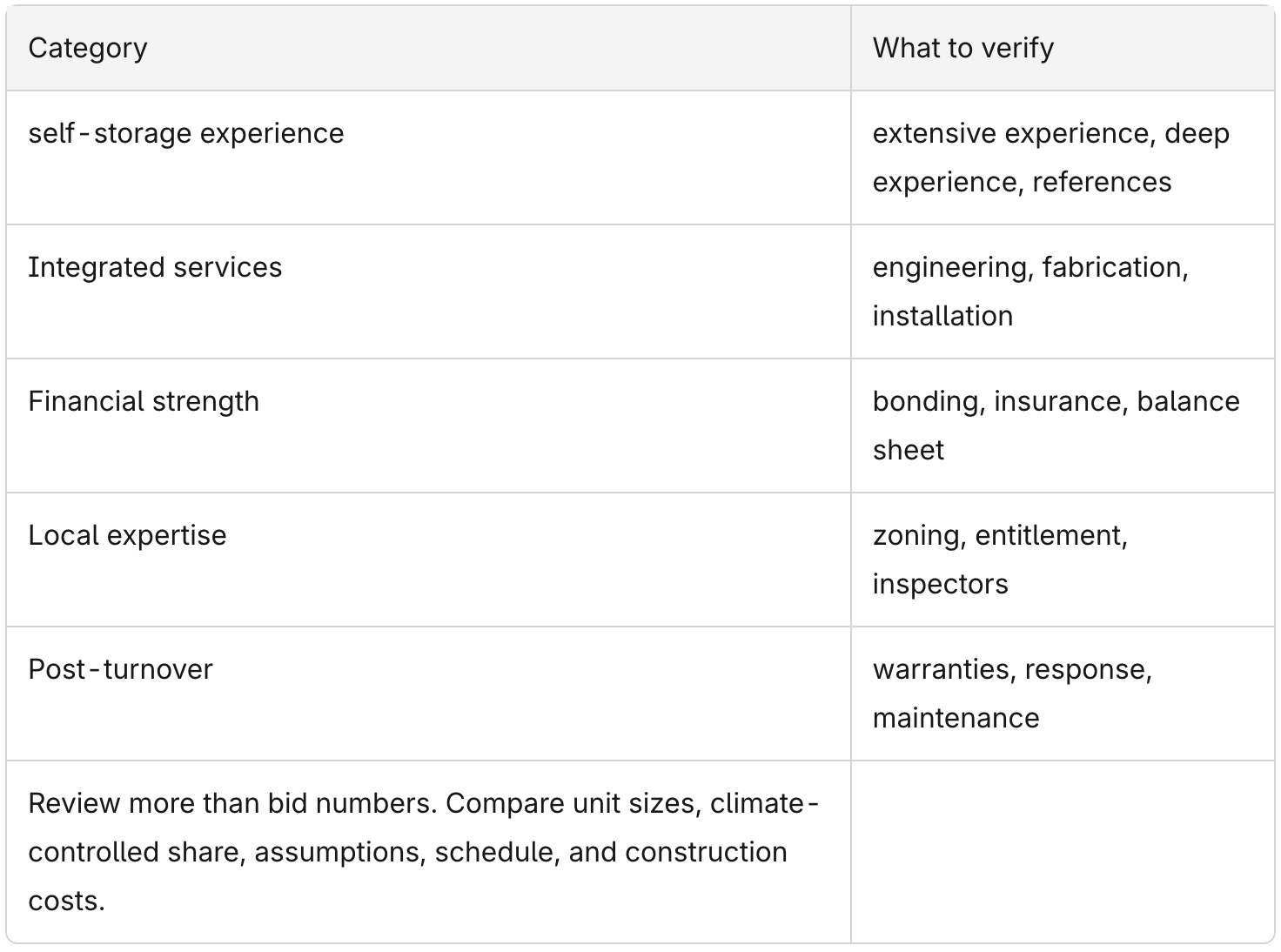
Past performance is the best proxy for success. Choosing a self-storage builder requires balancing specialized industry experience with local market knowledge. When hiring a company to construct a self-storage facility, prioritizing their industry-specific experience, financial stability, and local zoning expertise minimizes delays—many of these criteria are summarized in key considerations before hiring a self-storage construction company.
Self-storage buildings offer a variety of individual storage room sizes, with the most popular being 5×10, 10×10, 10×20, 10×30, 15×20, and 20×20 square feet. Approximately 40% of a storage facility’s client base demands climate-controlled units, which can increase rental prices by 25% to 60% while only adding a cost of about 10 cents per square foot. Owners weighing this premium should understand the benefits of building a climate-controlled facility. Higher-end self-storage units may provide amenities such as climate control, around-the-clock access, and power outlets within individual units, enhancing customer experience.
Questions to Ask About Self Storage Project History
Ask every bidder:
How many self-storage facilities over 90,000 square feet have been built since 2020?
What percentage of revenue is self storage industry work?
How many 3+ story self-storage construction project examples?
What was the GMP-to-final cost variance?
What was the schedule variance?
Which REITs can verify previous projects?
Are you licensed, bonded, and insured?
What is your standing with the Better Business Bureau, business bureau records, and relevant self-storage organizations?
Also, verify financial standing; some contractors may go bankrupt mid-project, leaving clients in a difficult position. Hidden costs and contractor bankruptcies are major risks in commercial construction.
Integrated Design and Preconstruction: Eliminating Scope Gaps Before You Build Storage Units
For institutional storage development, preconstruction is where risk is removed. Top-tier construction companies offer detailed feasibility and pre-construction planning with realistic timelines and material costs. Developing a comprehensive plan—including site layouts, construction workflows, and development strategies—is crucial to minimizing risk and ensuring project efficiency. A competent construction team can minimize surprises and foresee potential roadblocks before they cost time and money.
Storage Building Company can work closely with owners, engineers, and architects on market research, test fits, stacking plans, steel options, doors, partitions, climate-controlled areas, and security systems before the entire project is priced, drawing on multi-level self-storage services that streamline structural, exterior, and interior systems.
Design‑Build and Single‑Source Coordination Advantages
Design-build compresses decisions. A fragmented model splits responsibility among the shell GC, storage vendor, the MEP trades, and the installers. Storage Building Company provides tailored multi-level self-storage solutions with single-source coordination for self-storage construction, storage construction, and installation, so the entire process is less of a daunting process.
Technical Considerations for Multi‑Story Self Storage Projects
Multi-story buildings require decisions on structure, foundations, vertical space, and codes such as IBC 2018 or IBC 2021. Experienced builders evaluate structural steel with concrete slab on metal deck, precast, or hybrid systems based on soil, height, budget, and operational efficiency when delivering multi-story self-storage projects.
The cost to build storage units starts with land costs and parcel sizes, with a facility of 40,000 square feet typically requiring a land parcel size of 2 to 3 acres. The ideal minimum size of a self-storage facility is usually 40,000 square feet of rentable space, which most often requires two to three acres of land.
Climate Controlled and Building Envelope Strategy
Climate-controlled storage depends on continuous insulation, air barriers, vapor control, sealed penetrations, HVAC zoning, and dehumidification. Facilities utilizing modern green building practices can save heavily on energy consumption over the long term, especially when owners apply key considerations in building climate-controlled self-storage. Non-specialists often under-insulate walls or misalign ducts, creating condensation and warranty claims.
Structure, Foundations, and Vertical Circulation
Poor soils, slopes, and groundwater affect foundations. Elevator and stair placement also affects code compliance, rental velocity, and customer reviews. A capable self-storage builder designs stacking diagrams that protect rentable units and simplify customer access.

Project Management for Institutional‑Scale Self Storage Development
REITs should not choose the lowest bid if it comes from cutting corners. Project management should include dedicated PMs, 3-week look-aheads, risk logs, procurement plans, RFI tracking, and budget controls.
Developing land for self-storage facilities can be costly, with additional expenses for electricity, plumbing, and security systems adding $15 to $45 per square foot to the overall construction cost.
Cost Control, Value Engineering, and Risk Management
For single-story units, construction costs generally range from $25 to $40 per square foot, while multi-story self-storage units typically cost between $42 and $70 per square foot. Current institutional multi-story facility budgets can run higher in dense markets, so assumptions must be tested early. Storage Building Company focuses on cost-effective value engineering that preserves unit count, climate performance, and operator standards, and owners can request a detailed project quote early to align scope and budget.
How to Compare Self Storage Builders: A Practical Framework for REITs and Developers
Use a weighted scorecard:
Red Flags to Watch for When Hiring a Self-Storage Construction Company
Watch for vague climate answers, few storage facilities, no multi-story projects, weak references, unrealistic timelines, or reliance on third-party vendors. Before hiring a contractor, ensure they are licensed, bonded, and insured, and check their standing with the Better Business Bureau and relevant self-storage organizations. When selecting a contractor, ask for references and check previous projects to assess their quality of work and experience in building self-storage facilities.
Why Storage Building Company is the Right Partner for Multi‑Story Self Storage Construction
Storage Building Company aligns with what institutional owners need: specialized expertise, integrated delivery, predictable reporting, and fewer scope gaps. As a storage building company, we support self-storage units, self-storage projects, and complex storage builder designs nationwide.
Representative work includes a 2022 Southeast urban 4-story climate-controlled facility, a 2023 Midwest big-box conversion into a three-level storage facility, and a 2024 Western infill multi-story facility with tight access constraints. Each project required tailored solutions for unique requirements and needs.
Schedule a Preconstruction Review with Storage Building Company
Schedule a no-obligation preconstruction review through the contact form, phone number, or email listed on this website. We can help evaluate zoning, parcel fit, preliminary layouts, early budget ranges, construction project timing, and go/no-go investment assumptions before land closing or permit submission.
Frequently Asked Questions
How early should we bring a self-storage construction company into the development process?
Ideally, 6–12 months before the planned groundbreaking, before entitlement drawings are finalized. Early input shapes unit mix, structural grids, mechanical systems, and self-storage development underwriting.
What is a typical timeline for a multi‑story self-storage facility from NTP to opening?
Many 3–4 story projects take 10–14 months after notice to proceed, depending on utilities, inspections, façade requirements, and long-lead items like elevators, HVAC, doors, and steel.
Can one contractor handle both the base building and the self-storage interior build‑out?
Yes. A specialized partner like Storage Building Company can coordinate the shell with interior storage systems, reducing overlap, missed scope, and late changes.
What ongoing support should owners expect after opening?
Expect closeout documents, as-builts, O&M manuals, warranty support, and guidance on future expansion. Strong partners also help diagnose climate, access, or wear issues after opening.