
Self Storage Door and Hallway Systems for Modern Facilities
Introduction: Why Doors and Hallway Systems Matter in Self Storage
Storage Building Company specializes in installing doors and hallway systems in large self storage facilities across the United States. From new builds and multi-story expansions to climate-controlled conversions completed after 2018, our team handles the design, procurement, and installation of every corridor wall, roll up door, and protective finish that turns raw square footage into a revenue-generating property.
The decisions you make about self storage doors and hallway systems ripple across every performance metric that matters. Security depends on door strength, lock compatibility, and corridor visibility. Tenant experience depends on wayfinding, lighting, and how easily someone can navigate a cart down a hallway. And your bottom line depends on net rentable square footage, because every inch of corridor space is non-revenue area that subtracts from what you can rent. Self-storage facilities use specialized door and hallway systems to maximize rentable space, and self-storage doors and hallway systems transform building spaces into rentable units that generate income month after month.
Well-planned corridor systems and carefully specified self storage doors can maximize revenue by improving unit mix, allowing more small premium climate-controlled units that command higher per-square-foot rates. Efficient traffic flow, straight routing, and logical wayfinding reduce tenant complaints, improve turnover, and strengthen security camera coverage. Whether you're planning a new self storage facility, expanding an existing storage facility, or converting a former retail shell into climate-controlled storage, getting the doors and hallways right is one of the highest-leverage decisions in the entire project.

Planning Doors and Hallway Systems for a New Self Storage Facility
Early-stage planning is where the design process either sets up a facility for decades of efficient operation or locks in costly compromises. Once the slab layout, structural grid, roof height, and mechanical systems are set in permit drawings, hallway widths, door locations, and unit fronts become extremely difficult to change without expensive redesigns. Corridors and doors must be coordinated with the architect, structural engineer, code consultant, and civil engineer well before framing begins.
Storage Building Company coordinates hallway layouts with design teams to optimize unit mix and corridor efficiency from schematic design forward. This coordination includes:
Aligning corridors around structural bays so columns don't end up in unit fronts
Positioning entrances, loading zones, and freight elevators to minimize long, winding corridors
Integrating fire-rated partitions, egress paths, and sprinkler layouts into the corridor plan before they become afterthoughts
Ensuring unit doors are sized appropriately for their intended use, from compact 5×5 units up to large 10×30 spaces that might store a boat, RV, or business inventory
Hallway widths start at a minimum of 5 feet in most climate-controlled self storage designs. You should maintain interior corridor widths of at least 4 to 5 feet for easy navigation, though main corridors near entrances, elevators, and exits typically run 6 to 8 feet wide to accommodate two-way dolly and cart traffic. These wider corridors are not optional luxuries; they reduce congestion, speed up move-ins and move-outs, and prevent the kind of bottleneck damage that eats into maintenance budgets.
Placing larger units and drive-up style roll up doors closer to main entrances, loading zones, and freight elevators reduces tenant travel distance and minimizes the corridor space consumed by heavy traffic. Straight, well-lit corridors improve wayfinding, reduce confusion, and give security cameras unobstructed line-of-sight. Highly irregular hallway systems with zig-zags, frequent cross-corridors, and dead ends increase walking distance, create blind spots, and complicate sprinkler and smoke detection compliance.
On compliance: your facility must reference the 2018–2024 editions of the International Building Code (IBC), along with local fire codes. IBC Section 1020 requires a minimum corridor width of 44 inches for spaces serving more than 10 occupants, and 36 inches when occupant load is 50 or fewer. Dead-end corridors are limited to 20 feet in unsprinklered buildings and 50 feet when sprinklered. These aren't suggestions; they're the baseline your local authority having jurisdiction will enforce.
Types of Self Storage Doors for Modern Facilities
Self storage doors serve different purposes depending on where they sit in a facility. Interior unit doors handle daily tenant access on standard and climate-controlled units. Exterior and drive-up doors withstand weather, wind, and direct exposure. Specialty doors protect offices, utility rooms, and fire equipment areas. Each type must meet specific code requirements while supporting the overall functionality of the building.
Roll-up doors account for approximately 85% of all unit doors in modern self storage facilities. They are the most common choice for standard units because they save space above the opening (no horizontal tracking required), install quickly, and require minimal maintenance. Roll-up doors maximize usable storage space because they do not require horizontal tracking that would eat into the unit's interior area. Standard door sizes for storage units typically range from 3 to 4 feet wide for smaller units, scaling up for medium and large units.
There's an important distinction between interior and exterior doors. Light-gauge interior roll up doors work well for climate-controlled units protected from weather. Exterior-facing units and drive-up bays need heavier-gauge curtains, reinforced bottom bars, and stronger guide rails to handle wind loads and direct exposure. Self-storage doors must meet local building codes and compliance standards in every jurisdiction where the facility operates.
Swing doors and steel walk doors serve offices, utility rooms, electrical rooms, and ADA-compliant access points inside the storage facility. The Americans with Disabilities Act requires 5% of units to be accessible, which means doors should feature lever handles or looped pull ropes for accessibility at those locations.
Additional door components matter more than most owners realize:
Replaceable bottom vinyl seals prevent dust, pests, and moisture from entering units
Latches compatible with disc locks and over-locking hasps reduce pry points
IoT smart locks allow remote access and tamper detection for self-storage facilities, an increasingly popular option in premium and urban markets
Storage Building Company specifies door models and hardware to meet wind load, fire rating, and ADA requirements in each jurisdiction. We handle the specifications so that doors are included in structural and permit drawings from the start, not added in the field later where they cause conflicts.
Roll Up Doors: Performance, Durability, and Code Compliance
Roll up doors have been the backbone of most self storage projects built after 2015, thanks to significant improvements in design and manufacturing. A roll-up door consists of a steel curtain that rolls around a barrel mounted at the header, creating a compact assembly that fits above the door opening without requiring ceiling-mounted tracks.
The 3rd generation dead axle steel roll-up door features factory lubricated springs, where the axle doesn't rotate with the curtain. This reduces wear, eliminates the need for frequent lubrication, and ensures smooth operation across the door's lifespan. Roll-up doors are highly durable and designed for over 10,000 cycles, which translates to years of daily tenant use before major service is needed.
Enclosed barrel assemblies protect springs from dust, debris, and pests, which lowers long-term maintenance costs for facility owners. Some heavy-duty doors also include ratchet-tensioning systems for precise curtain balancing. Using 26-gauge galvanized steel for roll-up doors is the industry standard, providing a strong balance of durability, weight, and cost.
Modern door designs should minimize gaps that allow for forced entry, and high-performance doors enhance security and improve climate control efficiency by reducing air infiltration. The Trac-Rite Model 944 door is available in widths from 2'8" to 12'0", covering everything from compact interior units to wide drive-up bays.
Wind-rated roll up doors are essential in coastal and high-wind regions. Typical design wind speeds range from 115 to 150 mph depending on exposure category per ASCE 7. Storage Building Company works with engineers to verify door wind-load calculations and integrate them into stamped structural drawings. Skipping this step can result in non-compliance, insurance issues, or outright failure during a hurricane or severe storm.

Color, Branding, and Aesthetic Choices for Self Storage Doors
Self storage doors contribute significantly to curb appeal and brand identity, especially along street-facing elevations. The contrast between door colors, wall panel finishes, and accent trims can dramatically alter how tenants and passersby perceive a facility, and it can influence the rental rate premiums you're able to command.
Factory-finished color ranges typically include 20 to 30 standard options. Trac-Rite doors are available in 27 factory-finished standard colors, spanning whites, tans, grays, blues, and bold accent tones like red, green, and royal blue. This range lets you match brand guidelines without custom paint charges or extended lead times.
Storage Building Company helps owners select color schemes that align with brand guidelines and municipal design standards. In markets where HOA or design review boards have input, we verify that chosen colors meet approval requirements before ordering. Contrasting door colors for premium units or climate-controlled areas can visually differentiate higher-value spaces. For example, pairing light stone wall panels with royal blue or charcoal roll up doors signals to prospective tenants that they're looking at a premium product.
Beyond aesthetics, finish selection affects durability. UV-stable polyester coatings, galvanized substrates, and clear-coat options resist fading in high-exposure and coastal settings. Pick finishes that hold up over time, because repainting hundreds of doors is a cost you want to avoid.
Designing Effective Hallway and Corridor Systems
Hallway systems and corridor systems are both the structural and visual backbones of interior self storage. They define the tenant experience, control how much area is devoted to non-revenue space, and establish the security posture of the entire building. Self-storage hallway systems enhance security and deter unauthorized access when designed with solid partitions, clear sightlines, and controlled entry points, and successful projects start with understanding broader self-storage construction resources and best practices.
Storage Building Company designs corridors to maximize net rentable square footage while meeting egress and fire safety codes. In single-story climate-controlled buildings, double-loaded corridors with units on both sides are the standard. Multi-story buildings use main corridors that span each floor, with shorter cross-corridors branching to unit groupings. The goal is always straight, continuous main arteries for wayfinding and code-compliant egress.
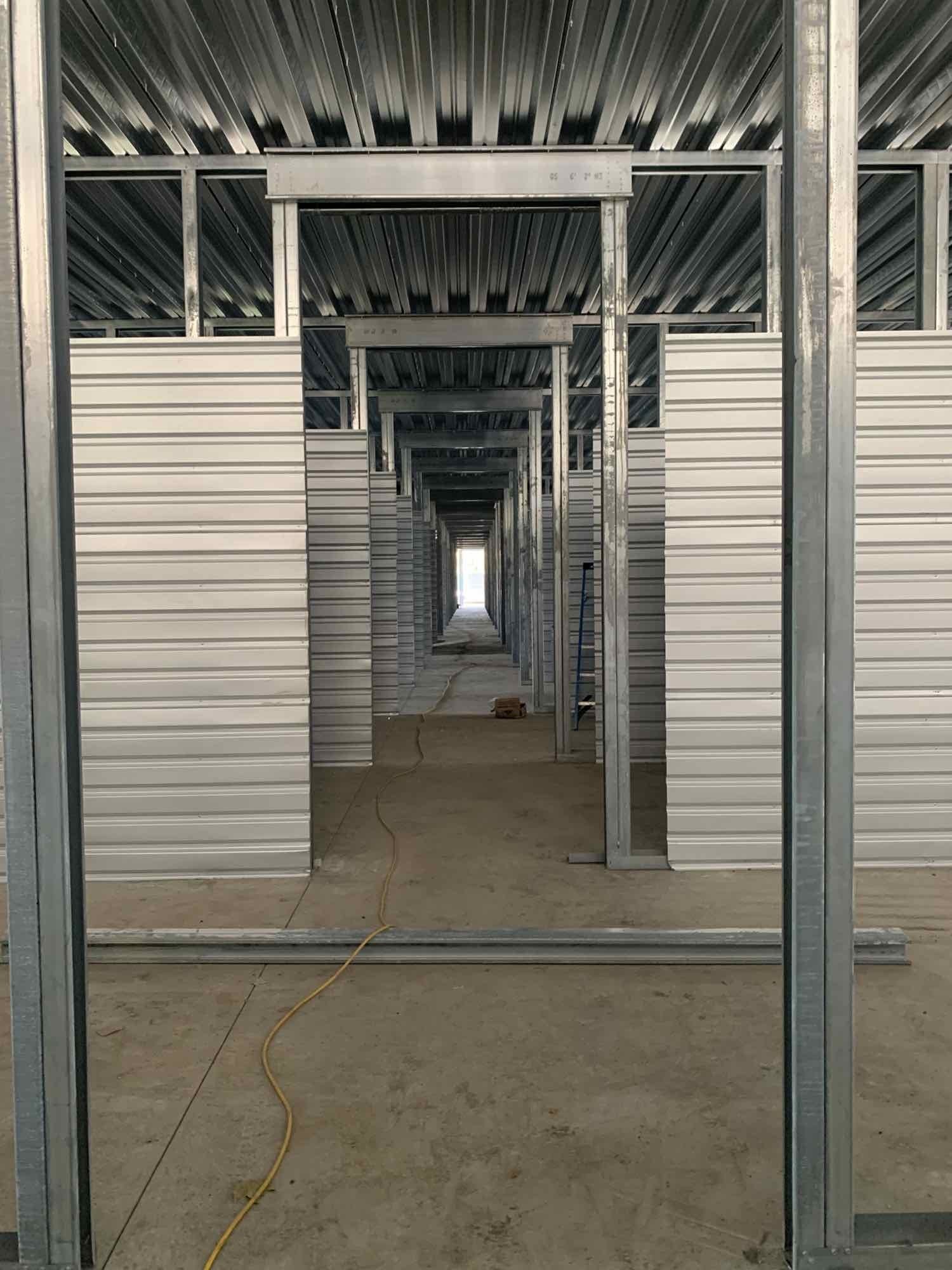
Hallway systems involve pre-engineered metal partitions that create individual units with clean, uniform fronts. These partition systems include wall panels, headers above doors, jambs, and door framing, all engineered to integrate with the corridor ceiling or structural deck above. Components for self-storage systems are designed for quick assembly, which keeps installation timelines tight and labor costs manageable.
Hallway systems also improve workflow for staff managing the facility. When corridors are logically laid out with consistent numbering and clear decision points, maintenance teams spend less time navigating and more time on productive tasks. Ceiling height in interior corridors typically runs 8 to 10 feet, sometimes more in buildings with vaulted ceilings or ceiling plenums. Lighting placement and camera locations must be planned alongside the corridor layout to eliminate dark areas and ensure complete surveillance coverage.
Wall, Header, and Panel Options in Corridor Systems
Wall and header details shape the interior look and durability of a storage facility and directly influence how tenants perceive the quality of the product they're renting.
Flush hallway systems feature flat panels that offer a modern appearance. These smooth, sleek panels are often specified in premium, high-rent, climate-controlled facilities where tenants expect a finished interior. They cost more due to tighter material tolerances and alignment requirements, but they eliminate the perception that the facility is industrial or cheap.
Corrugated hallway systems use corrugated steel panels and are budget-friendly while delivering higher impact resistance. The ribs and undulations in corrugated panels absorb minor dents and hide wear, making them a strong choice for high-traffic secondary corridors. Many facilities mix styles: flush panels in main corridors to enhance first impressions, corrugated panels in back corridors where durability matters more than appearance.
Metal gauge options center on 26-gauge galvanized steel, with protective coatings including galvanization, galvalume, and zinc treatments for corrosion resistance in humid or coastal environments. Storage Building Company installs both flush and corrugated corridor systems and can mix styles within a single project for design zoning, letting you allocate your finish budget where it has the greatest impact on tenant perception and revenue.
Safety and Protection Features in Hallway Systems
High-traffic corridors take a beating. Every move-in and move-out brings heavy furniture, loaded dollies, and carts that scrape walls, dent corners, and chip finishes. Without protective details, you'll face constant repair costs that erode your return on investment.
Common protective components include:
Kick plates cover the bottom 12 to 18 inches of hallway walls to prevent damage from foot traffic, carts, and dollies. Install corner guards and kick plates to protect walls from moving equipment as a baseline specification, not an upgrade.
Corner guards protect hallway corners from damage caused by moving carts. Aluminum diamond plate options extending up to 8 to 10 feet high at outside corners along turning points are standard in busy corridors.
Mid-span horizontal bracing prevents wall panels from bowing or deflecting in corridors longer than 20 to 30 feet. Use galvanized structural supports to prevent wall deflection in hallway systems, maintaining straight lines and structural strength over time.
Hem-and-channel construction eliminates sharp edges on panel terminations, reducing the risk of cuts or snags for tenants and staff.
Storage Building Company routinely includes these protection details in specifications for large projects over 40,000 rentable square feet. The upfront cost is minor compared to the ongoing expense of patching, repainting, and replacing damaged panels in corridors that weren't built to handle real-world traffic.

Hallway Systems for Climate-Controlled and Conversion Projects
Climate-controlled self storage and adaptive reuse conversions rely heavily on interior hallway systems. When you're converting a former retail building, warehouse, or industrial shell into rentable storage, the corridor system is what transforms empty floor area into organized, secure, climate-managed units, and experienced partners in self-storage conversions and retrofits can help you maximize the value of those existing structures.
Storage Building Company designs and installs corridor systems inside existing shells, aligning partitions with structural columns, beams, and HVAC zones. In conversion projects, the existing structure constrains where corridors and doors can go. Column spacing, roof height, floor load capacities, and envelope condition all dictate the layout. Our team works within these constraints to extract the most efficient unit mix possible from the available area, drawing on a portfolio of completed self-storage projects across multiple states.
Routing mechanical, electrical, and sprinkler systems within corridor ceilings is standard practice, but it must be executed carefully. Ductwork, sprinkler piping, and lighting need to be concealed while maintaining minimum ceiling height and visual uniformity. Using wire mesh panels above partitions allows airflow while preventing unauthorized access, a common solution for balancing ventilation, fire code compliance, and security. Per IBC requirements, corridor walls must extend to the ceiling or roof deck depending on required fire or smoke ratings.
Adding interior corridors can transform underused big-box spaces into multi-story, climate-controlled self storage facilities. One notable conversion in Philadelphia turned floors 4 through 7 of a mixed-use mid-rise into approximately 126,000 square feet of climate-controlled units using wire mesh ceilings, partitions, and hallway systems.
Insulation, vapor barriers, and air sealing at corridor walls and headers are critical in climate-controlled projects completed from 2019 onward. Weather seals at door jambs and thresholds, insulated ceiling assemblies, and vapor retarders in sidewalls prevent condensation and maintain the temperature and humidity levels that tenants are paying a premium to get.
A typical conversion timeline runs roughly as follows: shell assessment takes 1 to 2 months, layout design and permitting takes 1 to 3 months depending on the municipality, and procurement of corridor packages and doors has lead times of 6 to 10 weeks or more for factory finishes and custom colors. Many operators phase their conversions, opening one wing for rental while finishing the next, which helps cash flow during construction.
Lighting, Wayfinding, and Tenant Experience
Good lighting and signage are as important as structural elements in hallway systems. A corridor that's structurally sound but poorly lit feels unsafe, and a facility where tenants can't find their unit generates service calls and complaints.
Brightly lit hallways help tenants feel safe navigating the facility. LED fixtures are the standard for energy efficiency and consistent color temperature, typically around 4000K for brightness and neutrality. Space them to avoid dark shadowed areas, especially at corridor intersections and near doorways. Motion sensors or occupancy sensors reduce energy costs when corridors are unoccupied, and battery-backed emergency lighting is required for all egress routes.
Storage Building Company positions exit signs, unit number plates, and directional signage at decision points to simplify navigation in long corridors. Color-coded accent trims or banding can reinforce wayfinding by visually distinguishing wings or floors. In large or multi-story facilities, these small details prevent the disorientation that occurs when tenants face dozens of identical-looking hallways.
Security features tie directly into corridor design. Camera-ready corridors with clear sightlines and limited blind spots at hallway turns reduce the number of cameras needed and improve coverage quality. Solid wall partitions and secure door frames resist forced entry, while consistent lighting eliminates the dark zones that invite tampering.
Storage Building Company's Turnkey Approach to Doors and Hallway Systems
Storage Building Company provides a full, integrated doors and hallway systems service for self storage owners. Rather than splitting the work across multiple vendors and hoping everything aligns, our team handles layout design, engineering coordination, procurement, and installation under one contract as part of our broader multi-level self storage services.
This integrated approach eliminates the field conflicts that commonly occur when door sizes don't match partition systems, when header clearances are wrong, or when hardware arrives that doesn't fit the specified frames. Coordinating doors, corridor systems, and partitions together reduces change orders and keeps construction on schedule.
Our experience spans both new self storage facilities and renovations. We've replaced outdated doors that lack wind ratings, upgraded narrow hallways to meet current IBC minimums, retrofitted protective finishes, and changed facilities from non-climate interior buildings into fully climate-controlled operations by adding complete corridor systems as part of our self-storage conversion and retrofit expertise.
Project management is built into every engagement. Schedule planning, staged deliveries timed to framing and slab completion, and installation sequencing that avoids trades conflict with electrical, mechanical, and sprinkler contractors are all part of how we keep large projects on track, especially on complex multi-level self-storage construction projects. After installation, we provide warranty management and door service support so owners are ready for occupancy without lingering punch-list items.
Typical Project Workflow for Large Self Storage Facilities
Here's how a typical 60,000 to 120,000 square foot self storage project moves from concept to completion when Storage Building Company manages the doors and hallway systems:
Step 1: Early consultation. The owner or developer meets with our team to review the site plan, target unit mix, loading requirements, desired customer experience, municipal design guidelines, and preliminary cost estimates. We learn the specific needs of the project before any panels are ordered, often beginning with an initial conversation through our self-storage construction contact team.
Step 2: Preliminary layout. Corridor layouts are drawn with unit grid established, counts by size confirmed, and roll up door sizes and locations mapped. Swing doors, corridor widths per zone (main versus secondary), and HVAC zone interfaces are all documented in an initial door schedule.
Step 3: Engineering review. Structural engineers confirm roof spans and column spacings. Wind load calculations for exterior doors are verified per ASCE 7 exposure categories and basic wind speed. Fire and smoke separations are reviewed per IBC requirements. ADA compliance for door widths and hardware is confirmed, supported by our dedicated SBC Structural engineering and fabrication capabilities.
Step 4: Procurement and scheduling. Doors, panels, frames, and hardware are specified with finishes and colors selected. Orders are placed with lead times of 6 to 10 weeks, aligned to major construction milestones. Staged delivery ensures materials arrive as framing and slab work completes, not before they can be installed.
Step 5: On-site installation. Experienced crews install corridor wall panels and headers, mount doors, set jambs and thresholds, install hardware, and complete finish work including protective plates and corner guards. A punch-list walk-through with the owner confirms that every door operates smoothly, seals function, ADA hardware works, and lighting levels are adequate.
This workflow is designed to be repeatable across projects of different sizes and types, giving owners confidence that their facility will be built to specifications and delivered on schedule, whether it's a ground-up multi-story self-storage facility or a dense urban site needing a tailored multi-level self-storage construction solution.
Key Considerations When Choosing Doors and Hallway Systems
This section serves as a checklist for owners planning a new self storage facility or major renovation. Before you choose your systems and select a partner, evaluate these factors:
Safety and fire compliance:
Fire ratings for corridor walls, partitions, and doors must meet IBC Chapter 7 requirements
Egress routes must provide adequate width and clear paths with no excessive dead ends
Emergency lighting and smoke detection must be integrated into corridor design
Security:
Disc and oval lock compatibility with minimal pry points on door frames
Camera-friendly corridors with clear sightlines to reduce blind spots
Modern door designs that minimize gaps allowing forced entry
Solid partitions and secure frames that resist tampering
Accessibility:
ADA-compliant door clearances, maneuvering spaces, and lever hardware
Accessible paths from facility entrance through interior corridors
At least 5% of units meeting accessibility standards
Maintenance and lifecycle costs:
High-quality materials ensure durability and longevity of hallway systems over the facility's lifetime
Anti-rust coatings, UV-stable finishes, and replaceable wear components (seals, springs) reduce long-term repair budgets
Protective features like kick plates and corner guards should be base-bid items, not afterthoughts
Energy efficiency:
Insulated partitions and weather-sealed doors in climate-controlled hallway systems reduce HVAC load
LED lighting with motion sensors cuts corridor energy consumption
Air sealing at jambs, thresholds, and panel joints prevents conditioned air loss
Code compliance:
Verify which edition of the IBC your jurisdiction has adopted (2018, 2021, or 2024)
Confirm wind-load standards per ASCE 7-16 or 7-22 and local amendments
Corridor width requirements, height limitations, and fire-resistance ratings all affect door and hallway system selection
Storage Building Company assists clients in evaluating these factors and translating them into a detailed specification that covers every door, panel, and protective detail in the project.
Questions to Ask Your Doors and Hallway Systems Partner
Before you request proposals from any provider, use these questions to evaluate their capabilities:
Can you show examples of past projects similar in size (60,000–120,000+ rentable square feet), type (climate-controlled, conversion, new build), and completion year?
Do you provide corridor and door schedules with shop drawings that integrate structural, fire-rating, wind-load, and ADA requirements?
What is your process for verifying wind load ratings on exterior and drive-up doors, and are your drawings and specifications stamped by a licensed engineer?
What options do you offer for door durability: gauge of steel, finish, color range, weather sealing, hardware, and enclosed spring assemblies?
How do you handle protective features for corridors-kick plates, corner guards, wall bracing-and what lifecycle maintenance costs should we expect?
What are your typical lead times for doors and hallway systems, especially with custom colors, wind ratings, or fire ratings?
How do you coordinate with other trades (electrical, HVAC, sprinkler, framing) to sequence delivery and installation without causing delays?
What warranty, service, or maintenance support do you provide after installation, including scheduled check-ups, replacement parts, and response to door malfunctions?
Storage Building Company can clearly answer every one of these questions with real project examples, engineered documentation, and references from facility owners across the country. If your current partner can't do the same, it may be time to evaluate whether they can truly meet the demands of your project.
Getting your doors and hallway systems right isn't a cosmetic decision. It determines how much rentable square footage you extract from your building, how secure your tenants' belongings are, and how your facility performs financially for decades. Whether you're planning a new self storage facility from the ground up or converting an existing property into climate-controlled storage, the partner you select for this scope of work shapes the outcome of the entire project.
Storage Building Company brings the engineering knowledge, installation experience, and code expertise to deliver doors and hallway systems that protect your investment and enhance your revenue. If you're ready to discuss your next project, reach out to our team to start the conversation.