
Self-Storage Construction Schedule Risks Hidden in Steel and Door Procurement
Multi-story self storage construction projects look straightforward on paper: repetitive bays, standard framing, hundreds of roll-up doors. But in 2026, that simplicity masks a procurement reality that is quietly wrecking schedules across the country.
Why Steel and Door Lead Times Can Quietly Wreck a Self-Storage Schedule
Picture a three-story, climate-controlled self storage facility in a major Sunbelt metro. In this context, self storage means a multi-story storage building with repetitive bays, heavy structural steel, and a high number of roll-up doors, where procurement often drives the schedule more than field production. The team hit every early milestone. Then structural steel arrived eight weeks late. Roll-up doors followed ten weeks behind schedule. The project slipped 60–90 days, missing its spring lease-up window and costing the developer serious money.
This article focuses on schedule risks specific to self storage construction - multi-story facilities with repetitive bays and high door counts - not generic commercial work. It is written for developers, general contractors, and project planners who need to manage procurement and scheduling risk before a multi-story project loses time and revenue. Understanding lead times is crucial for effective project scheduling, and in this context, "lead time" means the period from approved drawings to fabricated steel delivered to the job site, or from door submittal approval to doors installed and inspectable; several factors can affect that period, including supply chain disruption, documentation gaps, site conditions, weather, customs, and field sequencing.
Current 2026 realities: structural steel lead times are currently 14–20 weeks from domestic mills. Self storage door packages commonly run 10–14 weeks for stock colors and sizes, stretching to 18+ weeks for custom orders. Storage Building Company (SBC) is a specialist in multi-story self storage that tracks these figures in real time and builds them into project schedules from day one. By the end of this article, you will know where hidden procurement risks sit, which common scheduling mistakes cause avoidable delays, and which early actions best protect your opening date and job-site safety.

How Self-Storage Steel Packages Move Through the Supply Chain and Handle Supply Chain Disruptions
Structural framing and light-gauge steel are the true critical-path materials for multi-story self storage construction. In many 2026 construction projects, they matter more to the schedule than concrete or roofing membrane.
Here is how the supply chain moves, stage by stage:
Design and engineering - structural design, connection details, shop drawings (2–4 weeks)
Mill rolling - domestic mills schedule coil and shapes production; mill lead times currently range 14–20 weeks
Fabrication - columns, joists, purlins cut and assembled (6–8 weeks, but only after coil is in the fabricator's yard)
Galvanizing or painting - required for coastal or humid markets (add 2–4 weeks)
Trucking - delivery to the construction site (1–2 weeks depending on region)
Site receiving - laydown, inspection, prep for erection
The critical detail: a fabricator's 8-week promise cannot start until raw material from the mill is physically present. Shipping delays and limited equipment access at the construction site can extend total delivery timelines and slow receiving and erection beyond what a schedule shows. Specialty gauges and heavy galvanized coatings common in humid self storage markets often fall under tighter mill allocation, and order size significantly affects steel lead times. Self storage projects rely on repetitive cold-formed components - purlins, girts, hallway framing - that are sensitive to factors that affect component flow from coil supply, making a coordinated structural steel procurement strategy essential.
Current 2026 Steel Lead Times and What They Mean for Self Storage
The 2026 steel market is shaped by Section 232 tariffs at 50% on imported steel products, strong demand from industrial and infrastructure categories, and constrained domestic capacity. Steel imports have dropped roughly 30% since tariff enforcement tightened, removing the buffer that imports once provided.
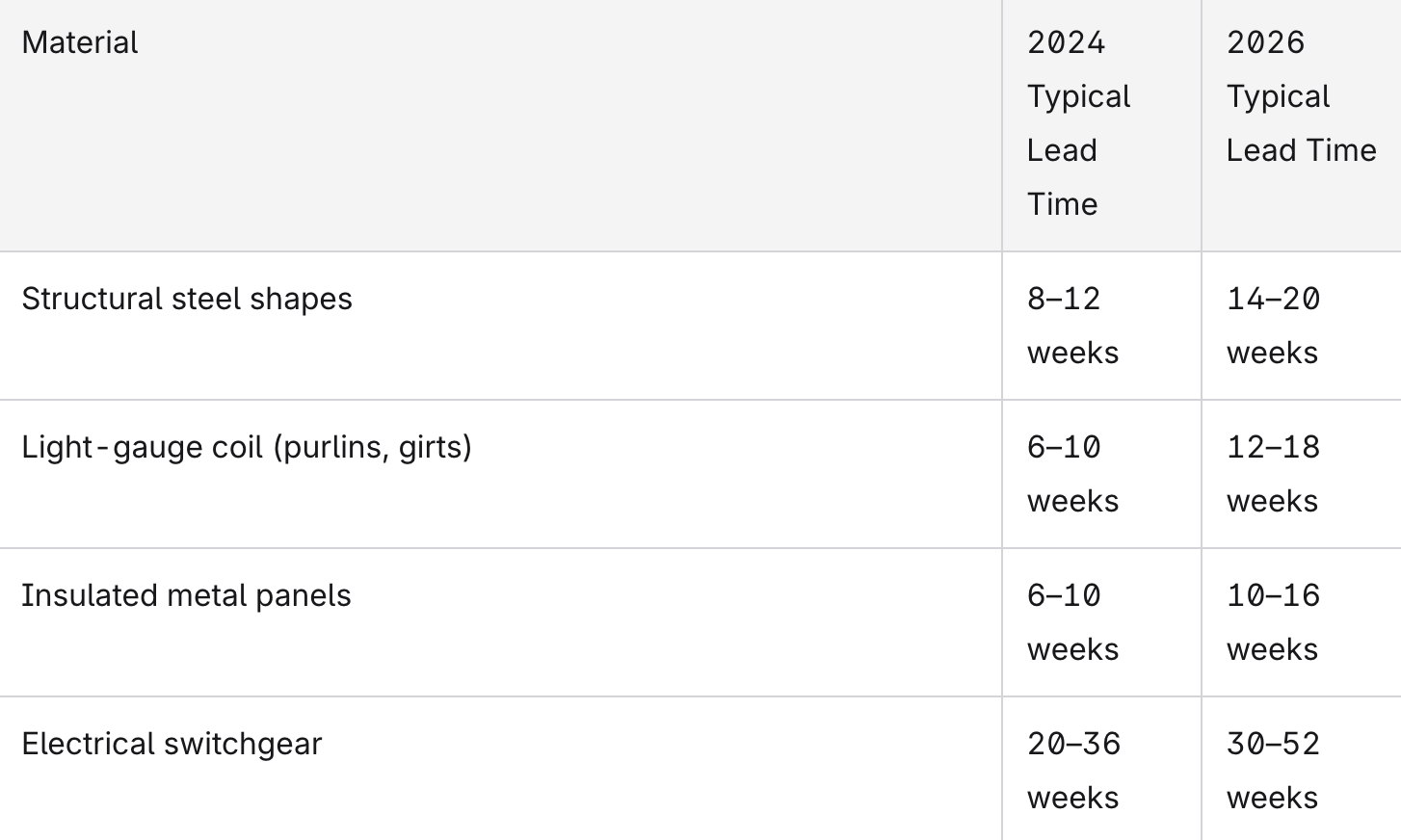
Steel mill product pricing is up roughly 13% year-over-year, resulting in higher prices and tighter budget pressure. Service centers carry lower inventories, so the "stock shape" cushion that used to save schedules when drawings slipped a few weeks is largely gone. For large multi-story facilities in the 80,000–150,000 NRSF range, buyers often find their project pushed into fully scheduled mill production rather than pulled from stock. Region, coating type, and thickness all change the real lead time - published averages are not enough for project planning.
The Hidden Door Problem: Roll-Up Door and Hallway System Lead Times
In multi-story self storage, the schedule often hinges on roll-up doors and corridor systems more than owners realize. Units cannot be leased or inspected until doors are in place and functioning. The finished facility is what customers interact with - self-storage units provide a secure way to manage extra belongings, with storage units coming in various sizes from small lockers to large garage spaces. Climate-controlled self-storage units protect sensitive items from extreme temperatures and humidity. Most facilities provide enhanced security measures like gated access and surveillance, and accessibility features may include drive-up access or indoor units. Self-storage facilities offer flexible month-to-month rental agreements, and common reasons for using self-storage include moving, home renovations, and seasonal storage. Items typically stored include furniture, seasonal decorations, and business inventory. Some items are prohibited from storage such as perishables and hazardous materials, and tenants rightly consider security measures, cleanliness, and rental terms when choosing a unit. None of that matters if doors aren't installed on time.
Typical 2026 door lead times:
Standard stock colors/sizes: 10–14 weeks
Non-stock colors or wind-rated packages: 14–18+ weeks
Large batch orders (300+ doors): extended timelines due to manufacturing and paint line capacity
Door production depends on the same steel coil supply chain, paint line backlogs, and labor issues in door plants. Risky assumptions that create delays include treating doors as a "late finish" item, waiting for final unit mix changes before ordering, or assuming all slat profiles are in stock.
Concrete impacts: one project lost 4–6 weeks because the chosen color was on allocation. Another saw certificate of occupancy delayed two months because corridors and ADA units lacked doors - the inspector would not approve occupancy regardless of how complete the rest of the facility looked.

Where Lead Time Assumptions Break Self-Storage Schedules
Self storage projects look "simple" compared to hospitals or data centers. That perception leads teams to underestimate how steel and doors can break a schedule and to repeat common self-storage construction mistakes.
Outdated lead time data. Many 2026 schedules still use pre-2022 benchmarks instead of leveraging up-to-date self-storage construction resources. Documentation errors like these can halt the construction process entirely when reality collides with the plan.
Confusing mill lead times with fabricator availability. A fabricator promising 8 weeks means nothing if the mill needs 16 weeks to deliver coil. Construction documents and CPM schedules must reflect confirmed procurement dates, not bid-day estimates.
Ignoring installer backlog. Subcontractors and door installers operate across multiple states. Labor disputes can lead to significant construction delays, and workers in high demand cannot simply appear when materials arrive, which is why choosing the right self-storage construction company is critical.
Site and sequencing risk. Site conditions and weather are major factors that affect schedule performance. Unsafe job-site safety conditions can also trigger delays and compliance problems. Late payments to contractors can create significant construction delays too. Construction delays often result from poor communication among teams involved in sequencing steel erection, corridor framing, elevator completion, and door delivery across three stories, underscoring the value of integrated multi-level self-storage construction services.
Mini-case: A 110,000 SF, three-story facility targeting November 2026 missed the spring leasing season. The team waited to lock steel and door procurement until after permit issuance. Steel lagged erection by eight weeks. Doors arrived ten weeks late. Poor planning and a failure to advance procurement cost the developer months of revenue.
Practical Strategies to Protect Your Self-Storage Schedule
Proper planning helps avoid costly disruptions in construction. Here is what developers and contractors can change in preconstruction to save weeks and protect opening dates.
Release conditional POs early. Issue purchase orders for structural steel and door packages during design development - at 60% construction documents - rather than waiting for 100% complete drawings. Lock color, grade, and coating specs in advance.
Build the schedule around real lead times. Integrate 2026 mill lead times into your baseline CPM. Make steel delivery and door production the critical path, not mobilization. Early procurement of materials is essential for maintaining project timelines and for aligning your self-storage construction cost planning with actual market conditions.
Pre-approve alternates. Qualify multiple door manufacturers, acceptable color ranges, and light-gauge suppliers so your team can substitute without re-starting the approval process. Technology like lead time dashboards can help track what is happening across the market in real time, especially for climate-controlled self-storage buildings where system choices directly affect performance.
Maintain communication cadence. Good communication prevents misunderstandings and delays in approvals. Hold weekly check-ins between the developer, GC, fabricator, and door supplier to validate current capacity, pricing, and delivery windows. This single discipline can answer questions before they become problems.
Budget for the present economy. Steel prices are up, demand is strong, and global logistics constraints push costs higher. Protect your budget with escalation allowances rather than hoping the market softens.
How Storage Building Company Helps De-Risk Steel and Door Procurement
Storage Building Company is a company that treats steel and doors as critical-path systems in every multi-story self storage project - not just line items on a bid sheet.
SBC's preconstruction team tracks real-time mill lead times, door production queues, and installer capacity across U.S. regions. That data feeds into conceptual schedules and budget discussions before a shovel hits dirt, helping clients and their contractors align structural systems, unit layouts, and door specifications with what the 2026 supply chain can actually deliver.
Specific services include lead-time-aware phasing plans, recommendations on when to release structural and door packages, and guidance on alternates when mills or door plants are at capacity.
Contact SBC today with your planned start date, location, and square footage to receive current steel and door lead time expectations tailored to your project by visiting our self-storage construction contact page. Turning hidden procurement risks into managed schedule decisions is the difference between hitting your lease-up window and watching it pass.